
Global Law Firm Strategy: Managing Boundary Risk in Partitioned Cross-Border Mandates

Hear me talk about it here When a cross-border transaction is partitioned between two law firms instructed in parallel, each operates under a defined retainer and each is discharged on completion. What sits between those scopes is boundary risk: how one firm’s legal work interacts with the other’s. In the historical lead-counsel model, a single […]
US–India Supply Chain Strategy: When Contractual Terms Become the Regulatory Limit

Watch in 1 min video here India’s new cross-border trade regulations, which took effect on 1 October 2026, moved foreign exchange compliance directly into the commercial drafting process. While FEMA 23(R)/2026-RB consolidates roughly 167 circulars under a single instrument, its core commercial reality is twofold: the lawyer drafting payment terms now establishes the regulatory compliance […]
Global Firm Management: Responding to Local Counsel Buy-Side Capture

Hear me talk about it here For decades, the standard operating model for inbound Indian investment was defined by a hub-and-spoke framework. A global private equity sponsor or multinational corporate would instruct their trusted relationship partner in London, New York, or Singapore. That foreign law firm would then act as the primary gatekeeper, subcontracting local […]
Trade Facilitation vs. Investment Protection: Structuring Inflows Under the India–New Zealand FTA

Watch in 1 min video here The entry into force of the India-New Zealand Free Trade Agreement (FTA) on 20 October 2026 marks a key milestone in bilateral market access, accompanied by a commitment to facilitate $20 billion in investment into India over 15 years. However, institutional investors must distinguish between market access trade […]
Beyond the Playbook: Aligning Business Development Systems with High-Margin Practice Positioning

Hear me talk about it here When law firm practice leaders collaborate with business development and marketing leadership to build new growth initiatives, they typically ask for a structured playbook. A documented framework provides a tangible deliverable that can be managed across practice teams, measured against metrics, and presented to firm leadership. However, it is […]
Foreign Investment Screening in Outbound M&A: Applying Domestic Beneficial Ownership Analysis to Global Transactions

Watch in 1 min video here Over the last decade, Indian corporations and their legal advisers have developed significant technical capability in beneficial ownership tracing and control analysis under domestic foreign direct investment (FDI) regulations. As Indian enterprises accelerate outbound acquisitions in critical technology, energy transition, and manufacturing supply chains, this compliance muscle memory becomes […]
The Answer Without Its Conditions

Here me talk about it here Practice development playbooks systematically decay because they codify procedural triggers while losing the structural commercial hypothesis that made the original strategy effective. When a practice codifies its business development workflow, it naturally anchors outreach to verifiable legal events: a statutory notification, a jurisdictional ruling, or an enforcement order. This […]
What Got Cheap, and What Got Expensive

Hear me talk about it here Generative tools can now produce a competent legal summary of a statute or judgment in seconds, making basic technical drafting universally accessible. This shift has created two immediate market realities: The baseline floor has risen: A well-drafted legal summary no longer demonstrates that an attorney invested significant time in […]
Where Claims Are Run vs. Where Disputes Originate
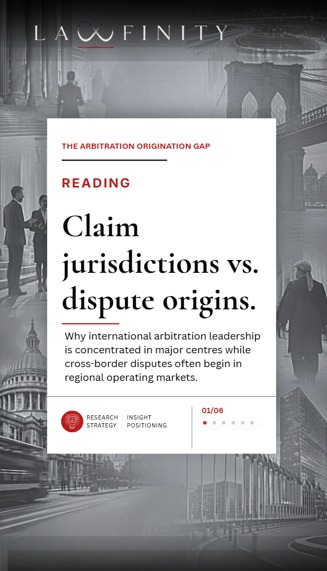
Watch in 1 min video here The global market for international arbitration is split by a structural geographic divide: major law firms concentrate practice leadership where claims are litigated, while the underlying disputes originate in regional operating markets. While Washington and London hold the institutional depth to manage formal arbitrations (the “second half” of a […]
From Arbitral Award to Asset Recovery: Dwelling on Drafting Gaps in Cross-Border M&A

Watch in 1 min video here International arbitral awards under the New York Convention framework routinely achieve prompt legal recognition. However, the subsequent asset recovery process can face multi-year procedural delays. This divergence is rarely attributable to defects in arbitral procedure or domestic enforcement law. Rather, it reflects the structural dynamics of post-transaction capital deployment […]