Corridor legal market intelligence on the fly-in, fly-out cap, the India desks now forming in Singapore, Dubai and Kuala Lumpur, and where the India-seated arbitration margin actually sits.
What Does the Fly-In, Fly-Out Cap Require?
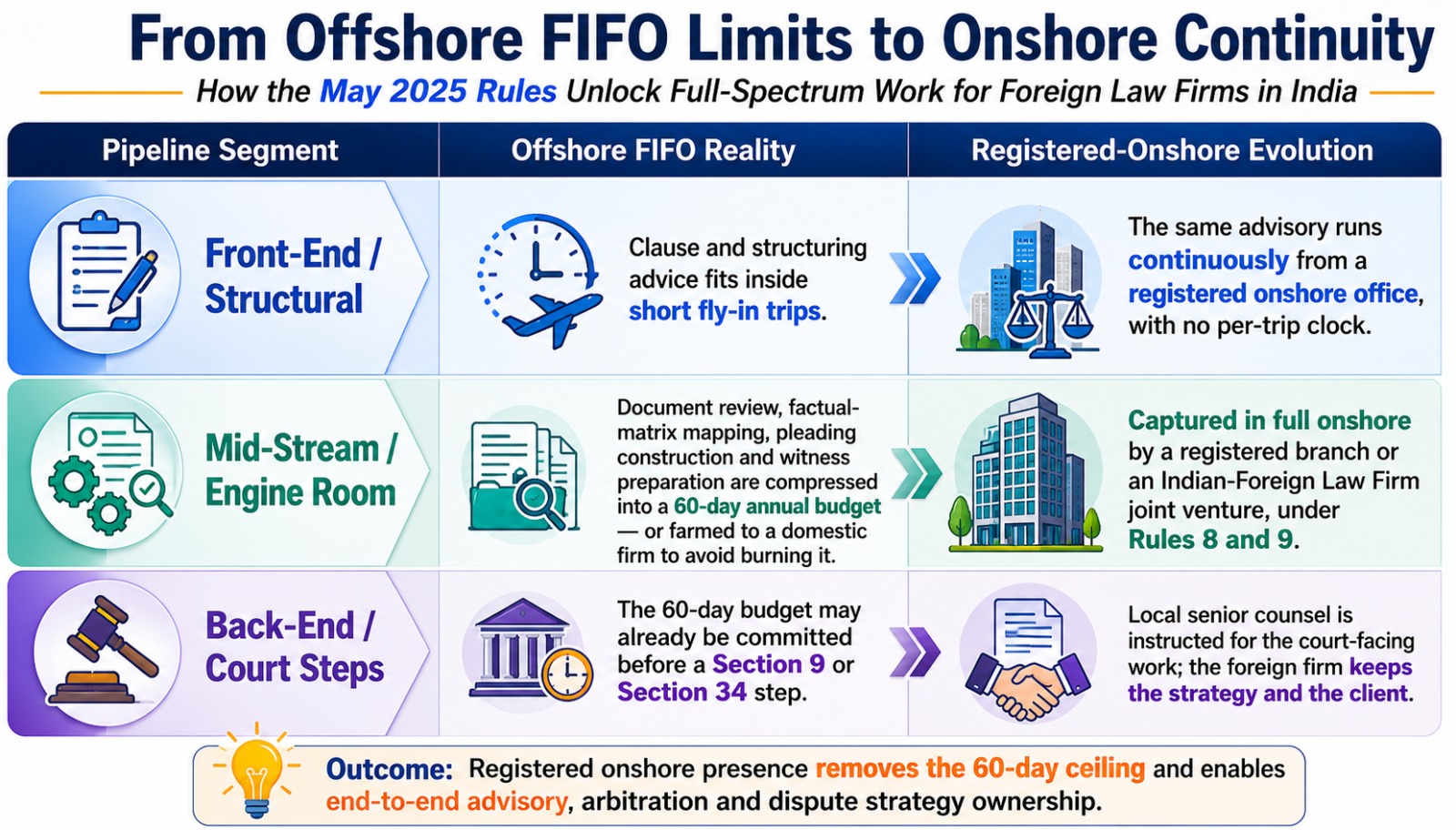
Under the May 2025 BCI rules, the India legal market entry routes now diverge sharply on one point of operational detail. An unregistered foreign firm advising in India on a fly-in, fly-out (FIFO) basis is capped at 60 days of presence in aggregate within any 12-month period, and must file an advance Form C declaration before each visit, naming the work, the areas of law involved and the client. Registration removes the cap. FIFO does not. That detail is one of the things that shapes who captures the margin on an India-seated arbitration.
Where Is India-Seated Arbitration Demand Forming?
The question falls most sharply on firms currently servicing India-seated disputes from London, Singapore and Dubai. The matters driving India cross-border dispute formation (the infrastructure, construction, energy, and private-equity and joint-venture disputes migrating into the Mumbai Centre for International Arbitration and the proposed GIFT City centre) are document-heavy and multi-party, and the MCIA Rules 2025 added joinder, consolidation and summary mechanics built for exactly that docket. The addressable market is sized in the caseload: MCIA recorded a 48% rise in new cases in 2024 to matters worth about INR 2,180 crore, then a further 79.5% jump to 61 matters in 2025. These are the sectors that generate cross-border legal work in India, and the proceedings in which presence is consumed not at the hearing but across months of disclosure and witness work.
Where Does the Engine-Room Margin Move?
The matrix below tracks how the cap reshapes cross-border mandate formation in India, and who ends up holding the client relationship.
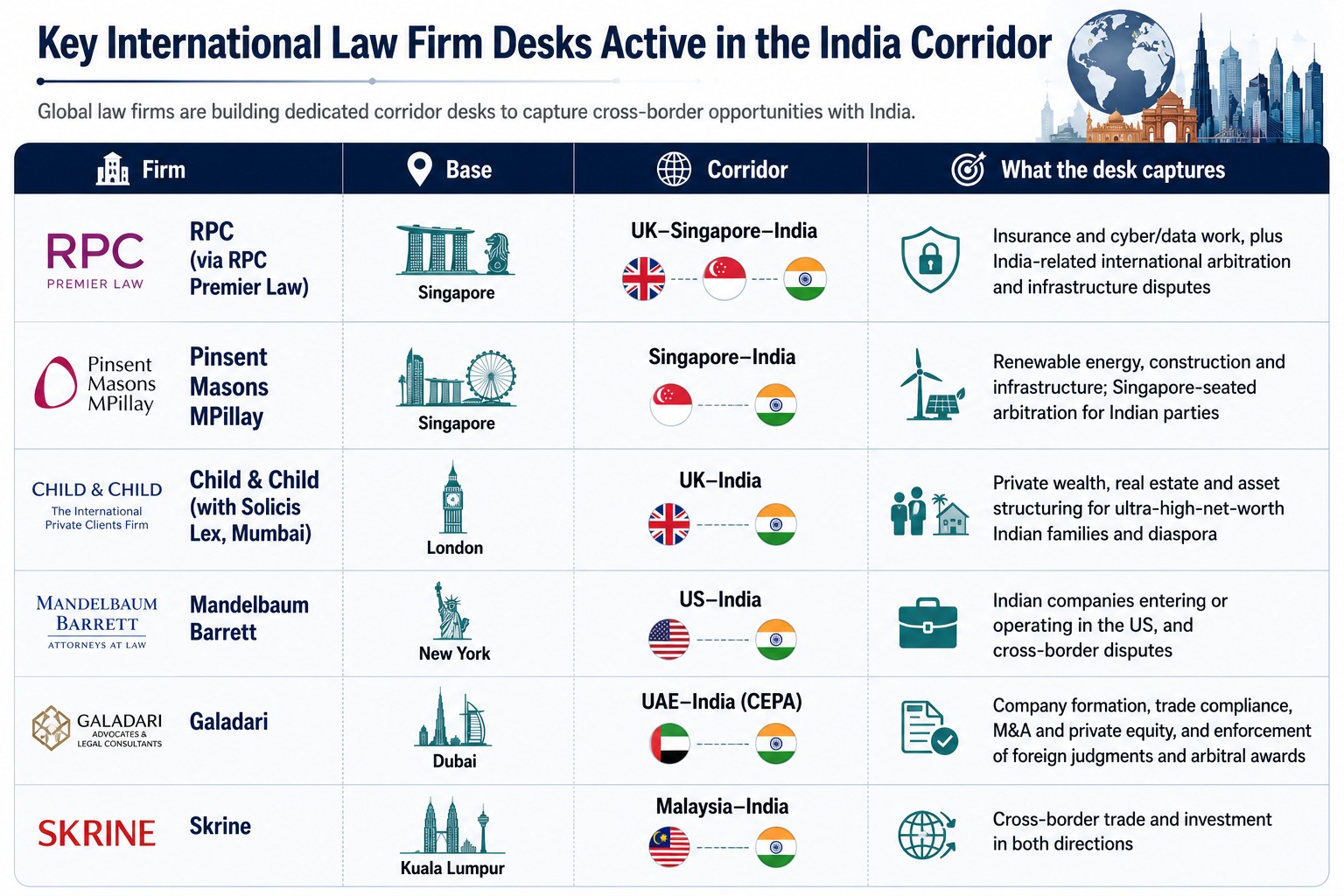
Who Is Building in the India Corridor?
The offshore prime-contractor model: the structure Herbert Smith Freehills and others built to run Indian arbitrations from London and Singapore runs into a structural limit on this particular work. 60 days in aggregate is consumed quickly during the disclosure and witness phases of a single large infrastructure arbitration. Every trip to manage that work requires a Form C declaration that names the client to the regulator. For a live, sensitive dispute that is a confidentiality consideration as much as a time one, as already flagged by practitioners advising Indian conglomerates.
Response I: A registered onshore branch can capture the leveraged billable hours directly under Rules 8 and 9, engaging Indian advocates as employees or associates for foreign-law support; where Indian-law capability has to sit inside the structure, the route is a dual-qualified hire or the new Indian-Foreign Law Firm joint venture, not an unregistered alliance of the kind the BCI is now litigating against. Baker McKenzie has signalled it intends to open an India office at the earliest opportunity.
Response II: This works the corridor from the other end. A reading of the India cross-border legal market competitive landscape shows the market is already building it: the corridor desk, run from the firm’s own jurisdiction to capture the foreign leg of an India-linked matter, where the BCI does not reach. These are home-turf practices aimed at the slice of the corridor that sits offshore by design, and several of these India desk launches in Singapore and elsewhere have been built through lateral partner moves.
Each of these desks does real work, and none is seen to be focusing on solving the India-seated problem. This is where the opening for onshore registration is. Read together, they divide the corridor sensibly: the India-Singapore, India-UK and India-UAE legal corridors serviced at home, and the India-seated engine room captured onshore. The position that becomes hardest to hold is the one in the middle: running a sustained India-seated arbitration remotely on a fly-in basis, where the 60-day ceiling makes the economics difficult and the billables margin tends to pass to a domestic firm.
How Should a Firm Position for the India Corridor?
Lawfinity’s Insight: For a sustained India-seated arbitration, the 60-day ceiling turns the choice of offshore practice from a relationship question into an operating-model one. The India desk strategy question is which leg of the corridor a desk is actually for: a home-jurisdiction corridor desk is a sound vehicle for the foreign-law leg, while the margin on India-seated matters favours registration and an onshore arbitration bench built early, because registration, not a London relationship, is the scarcer asset, and the queue forms ahead of the disputes, not after them.
Also, align the next Chambers Asia Pacific and Legal 500 submissions to India-seated arbitration capability as well as offshore “India Desk” presence and choose the integration vehicle before the first mandate lands, not during it.
Common Questions on the India Corridor and Foreign-Firm Desks
What is the fly-in, fly-out (FIFO) limit for foreign lawyers in India? Sixty days of presence in aggregate within any 12-month period for unregistered practice, with an advance Form C declaration required before each visit. Registration removes the cap.
Can a foreign law firm run an India-seated arbitration? Yes – a registered firm can act as counsel in an India-seated international arbitration involving foreign or international law. Sustaining that role from offshore on FIFO is harder, which is why the engine-room work tends toward onshore registration.
Which law firms have launched India desks in Singapore, Dubai and Kuala Lumpur? Among them, RPC and Pinsent Masons MPillay in Singapore, Galadari in Dubai, and Skrine in Kuala Lumpur, alongside Child & Child in London (with Solicis Lex) and Mandelbaum Barrett in New York.
How do lateral partner moves shape foreign firms’ India practices? Several corridor desks have been launched on lateral hires, which is a clearer near-term signal of where a firm is committing capacity in the India corridor than a general India Desk page.