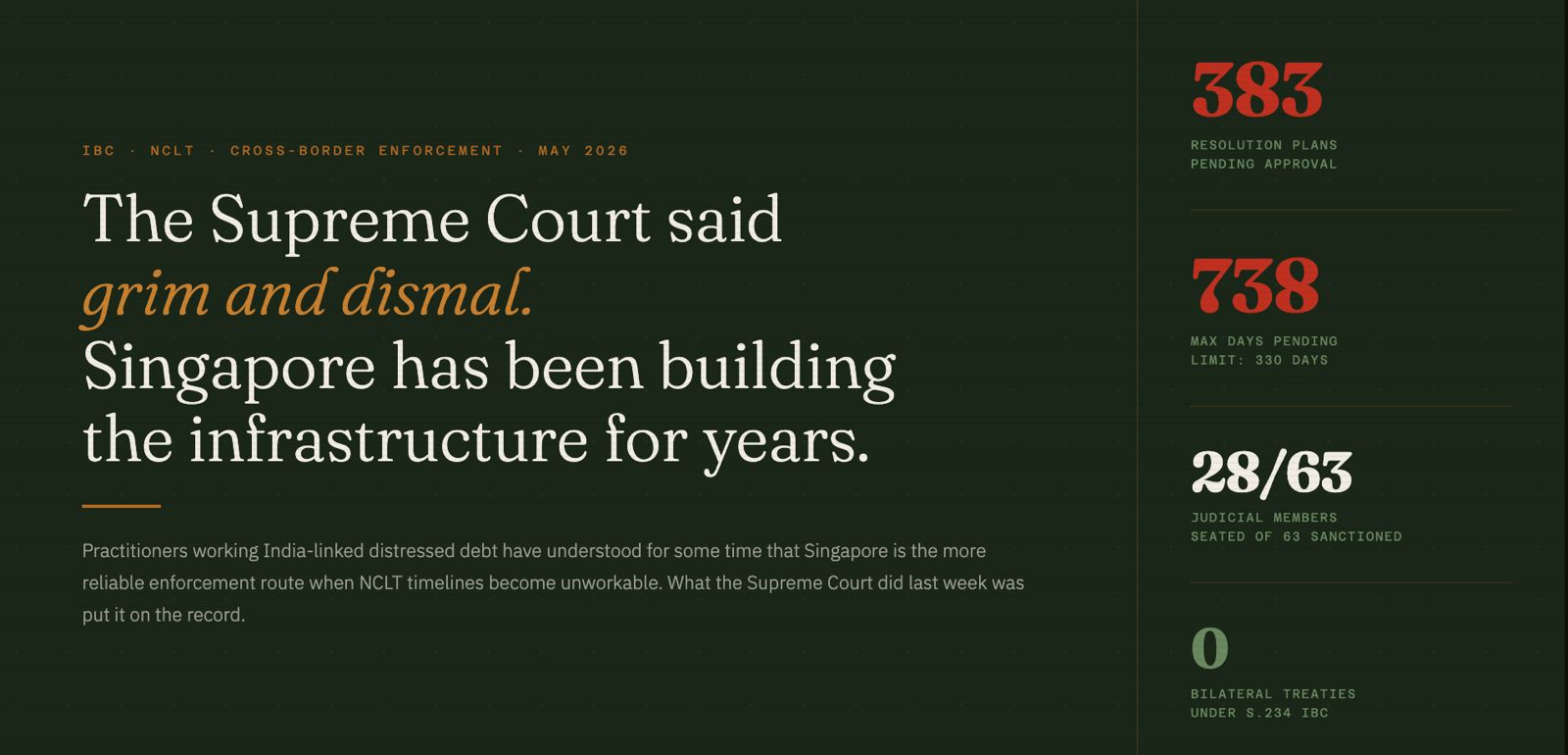
Practitioners working India-linked distressed debt have understood for some time that Singapore offers a more reliable path when NCLT timelines become unworkable.
What the Supreme Court did last week was say it on the record, in a suo motu proceeding, using the words grim and dismal, to describe a system where 383 approved resolution plans are sitting unacted on, some waiting four years for a hearing. The tribunal is running at less than half its sanctioned judicial strength.
That on-the-record confirmation changes something specific. It changes how clients approach the decision internally, what was a practitioners’ conversation is now a documented judicial finding.
Here is what the Singapore route looks like in practice and which firms are already inside it at different entry points.
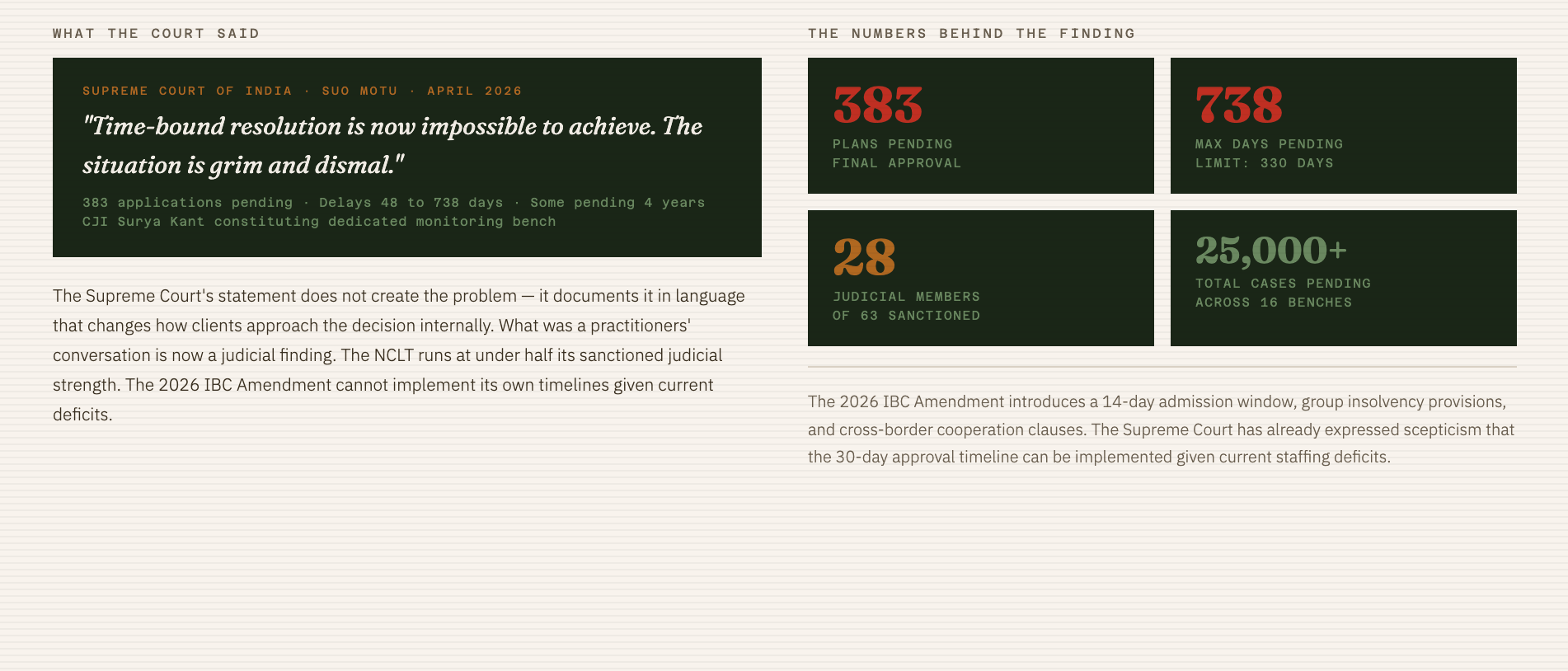
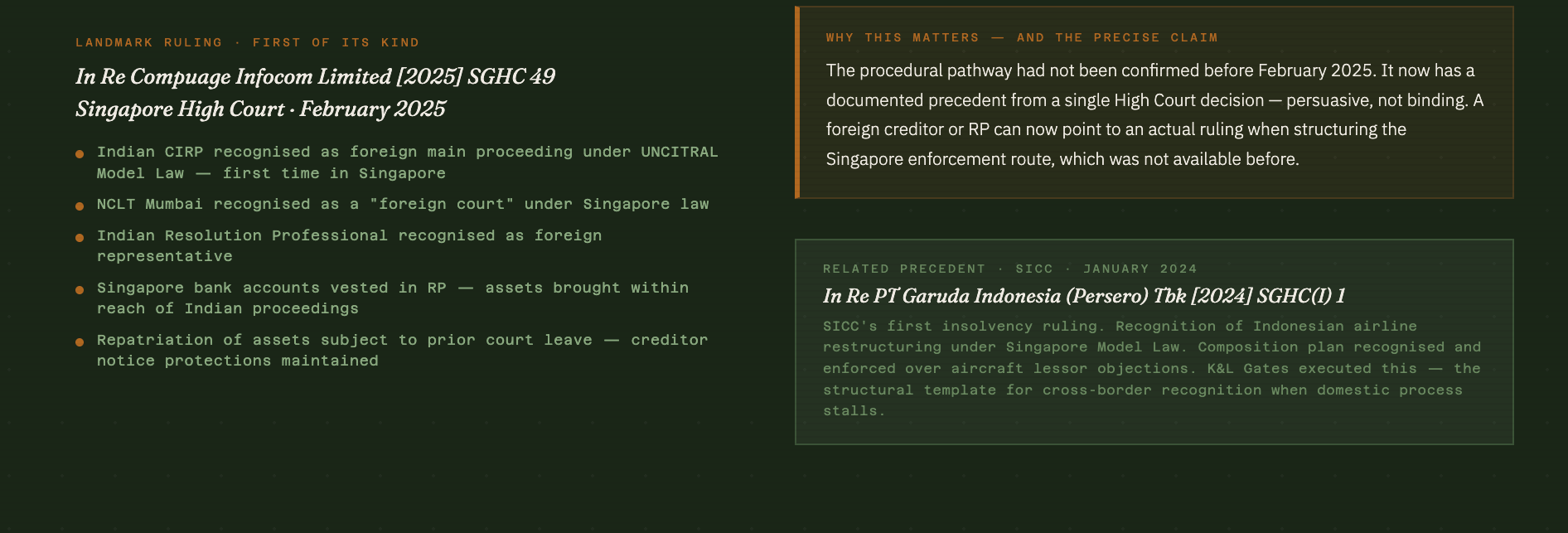
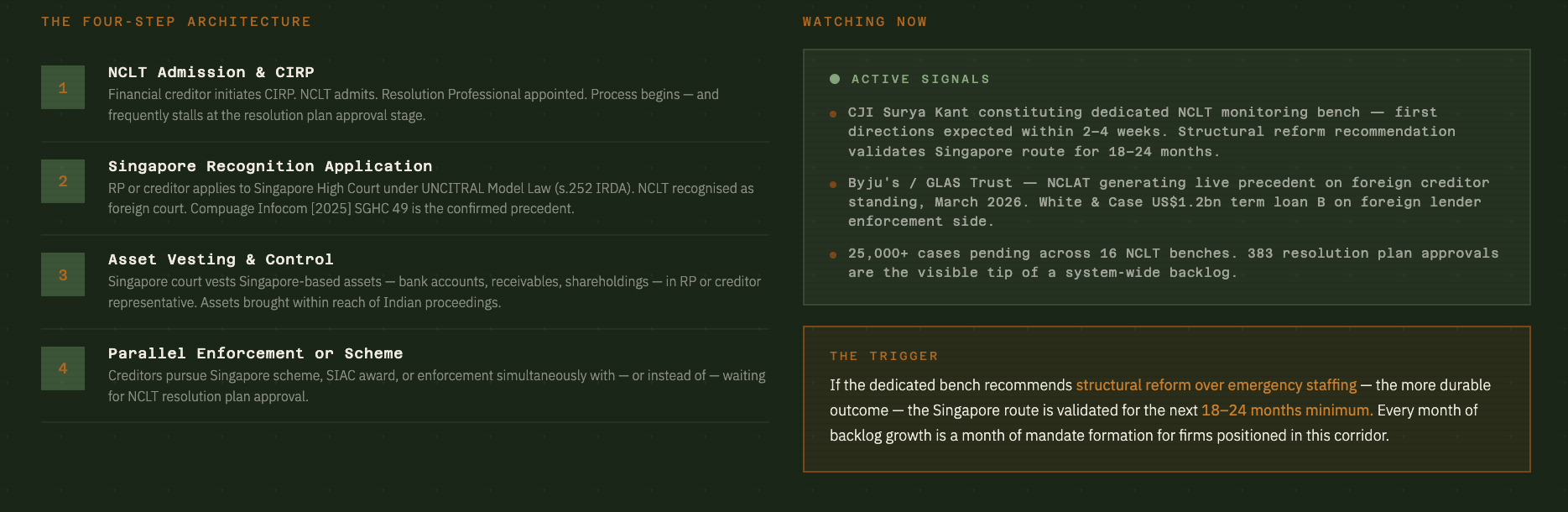
In February 2025, the Singapore High Court recognised an Indian CIRP as a foreign main proceeding for the first time, Re Compuage Infocom [2025] SGHC 49. An Indian resolution professional appointed by NCLT Mumbai walked into a Singapore court and got control of the company’s Singapore bank accounts. The NCLT was recognised as a foreign court. That procedural pathway, which had not been confirmed before, now has a documented precedent.
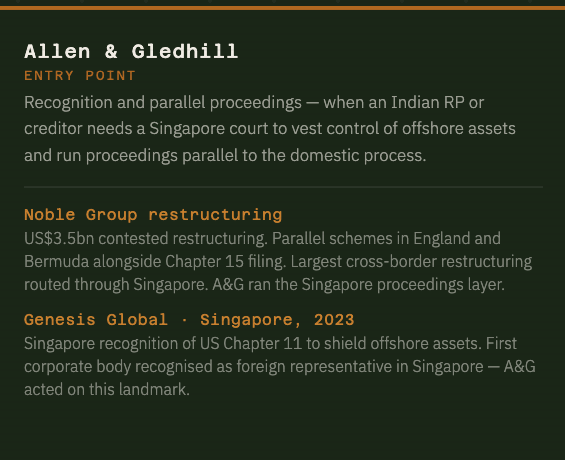
ALLEN AND GLEDHILL enters at the recognition and parallel proceedings layer. They acted on the US$3.5 billion Noble Group restructuring, parallel schemes in England and Bermuda alongside a Chapter 15 filing.
They represented Genesis Global in 2023 when it sought Singapore recognition of its Chapter 11 proceedings to shield offshore assets from creditors. When an Indian company’s resolution professional needs a Singapore court to vest control of Singapore-based assets, Allen and Gledhill is the firm already operating that mechanism.
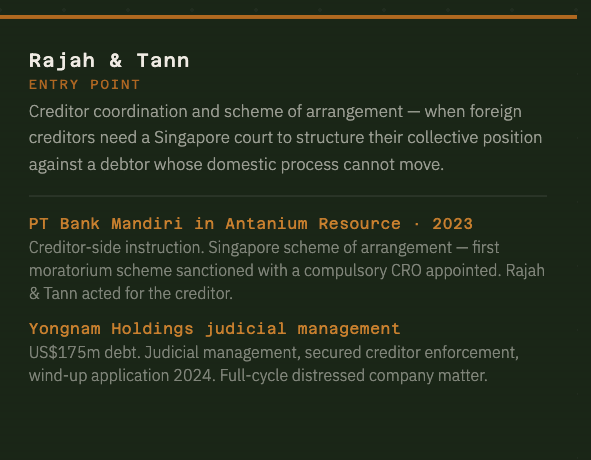
RAJAH AND TANN enter at the creditor coordination and scheme of arrangement layer. They represented PT Bank Mandiri as a creditor in Antanium Resource’s Singapore scheme in 2023, the first moratorium scheme sanctioned by the Singapore High Court with a compulsory chief restructuring officer appointed. When foreign creditors need a Singapore court to coordinate their position against an Indian debtor whose NCLT process is stalled, that is the Rajah and Tann entry point.
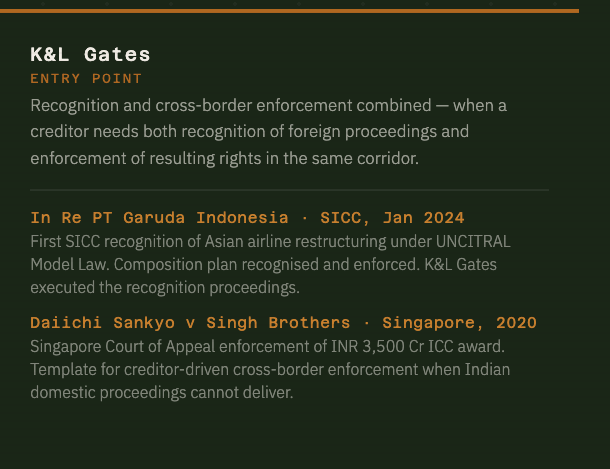
K&L GATES enters at the recognition and cross-border enforcement layer. They executed the Garuda Indonesia recognition proceedings in the SICC, the first time the court granted recognition of an Asian airline restructuring under the Model Law, in January 2024.
They handled the Daiichi Sankyo enforcement across Singapore, the template for creditor-driven enforcement when Indian domestic proceedings cannot move fast enough. When a creditor needs both recognition and enforcement in the same corridor, that is where K&L Gates has the named precedents.
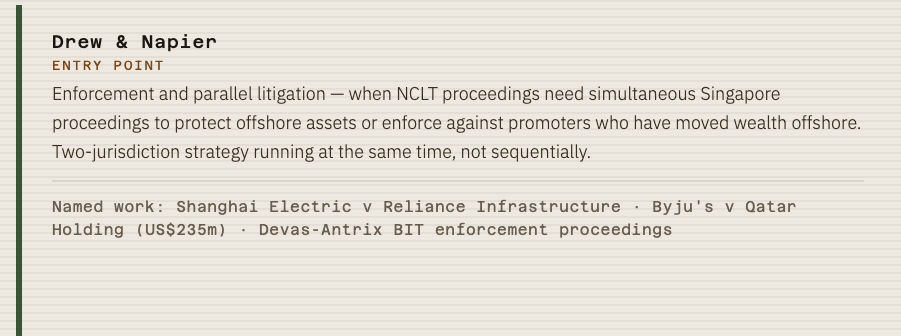
DREW AND NAPIER enter at the enforcement and parallel litigation layer, when the matter is already in NCLT but needs simultaneous Singapore proceedings to protect offshore assets or enforce against promoters who have moved wealth offshore. That is a different entry point from pure recognition, it is the firm you call when you are running a two-jurisdiction strategy simultaneously.
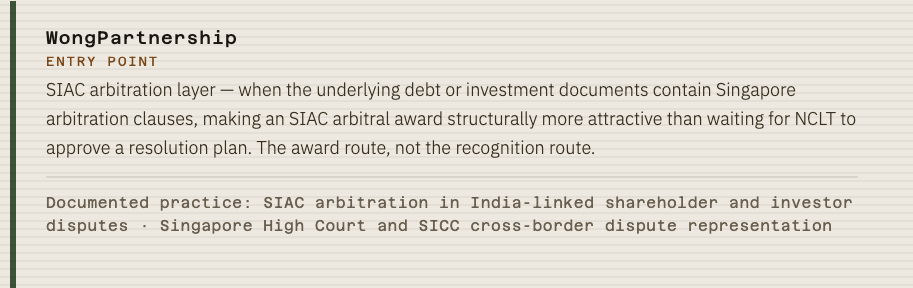
WONGPARTNERSHIP enters at the SIAC arbitration layer, when the underlying debt or investment documents have Singapore arbitration clauses, and the creditor’s strategy is to obtain an arbitral award in Singapore rather than wait for NCLT to approve a resolution plan. The NCLT backlog makes SIAC arbitration a structurally more attractive path for creditors whose documents allow it.
What the Supreme Court’s intervention this week does is make the case for the Singapore route easier to put in front of clients who needed documented, on-the-record confirmation. The practitioners who built this infrastructure were already running it. The client conversation just got simpler.

Lawfinity Intelligence Brief || India legal market intelligence.