An India legal market entry analysis: which routes are opened in India-seated arbitration by the rules, where the cross-border mandate margin now sits, and what a foreign law firm India strategy has to get right.
The Flashpoint: India’s New Legal Market Entry Rules
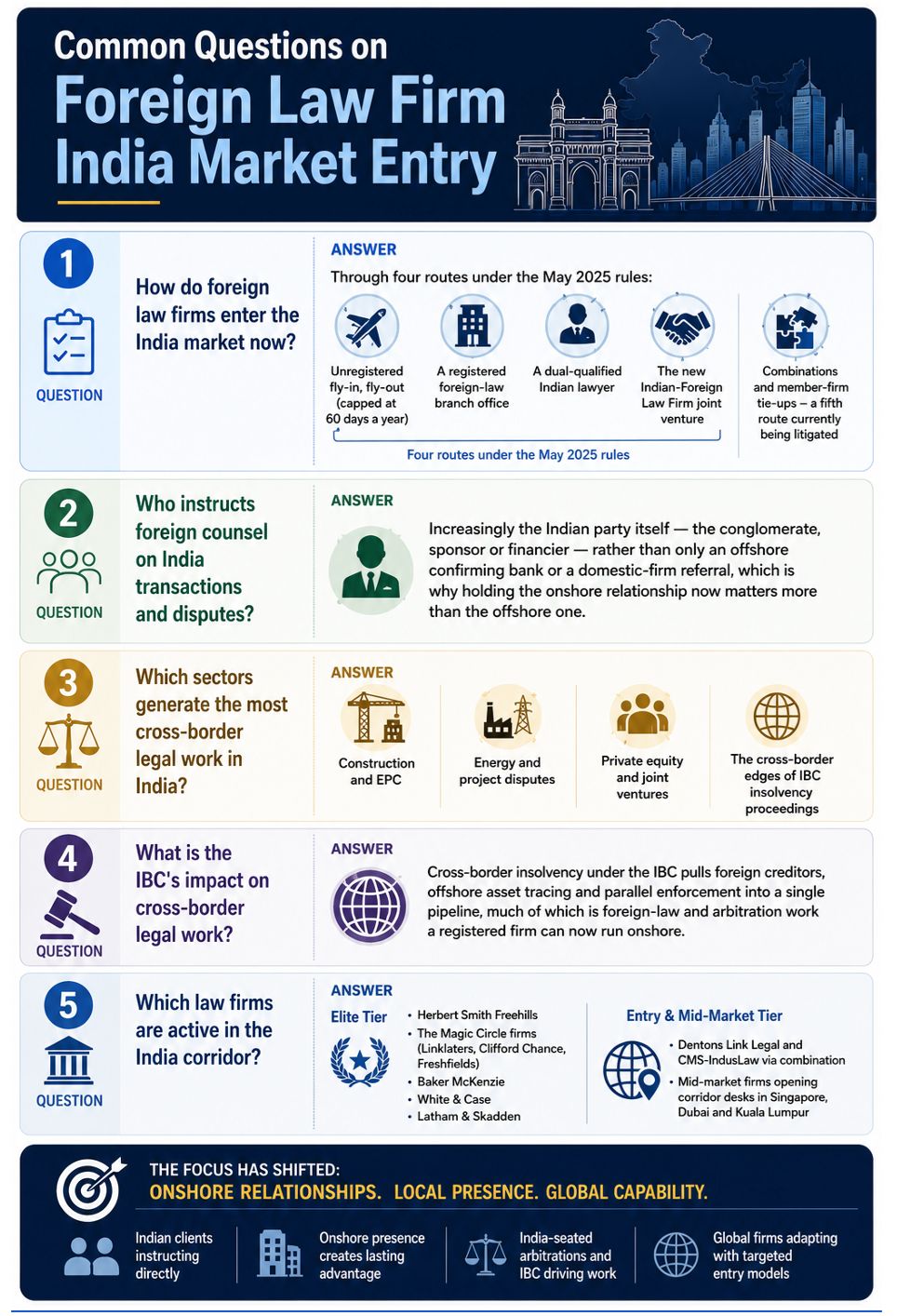
On 13 May 2025 the Bar Council of India (BCI) re-notified its rules on foreign lawyers, resetting the available India legal market entry routes. Registered foreign firms may now:
- advise on foreign and international law; and
- act as counsel in international commercial arbitrations seated in India where the dispute involves foreign or international law; and
- may engage Indian advocates as associates or employees for foreign-law support.
What stays closed is narrow: advising on Indian law, and appearing before Indian courts and tribunals. The reading that the rules leave foreign firms locked out of meaningful India work, mistakes the one low-margin activity that remains shut for the whole pipeline.
The Corridor & Sector Heat Map: India-Singapore, India-UK and India-UAE Legal Corridors
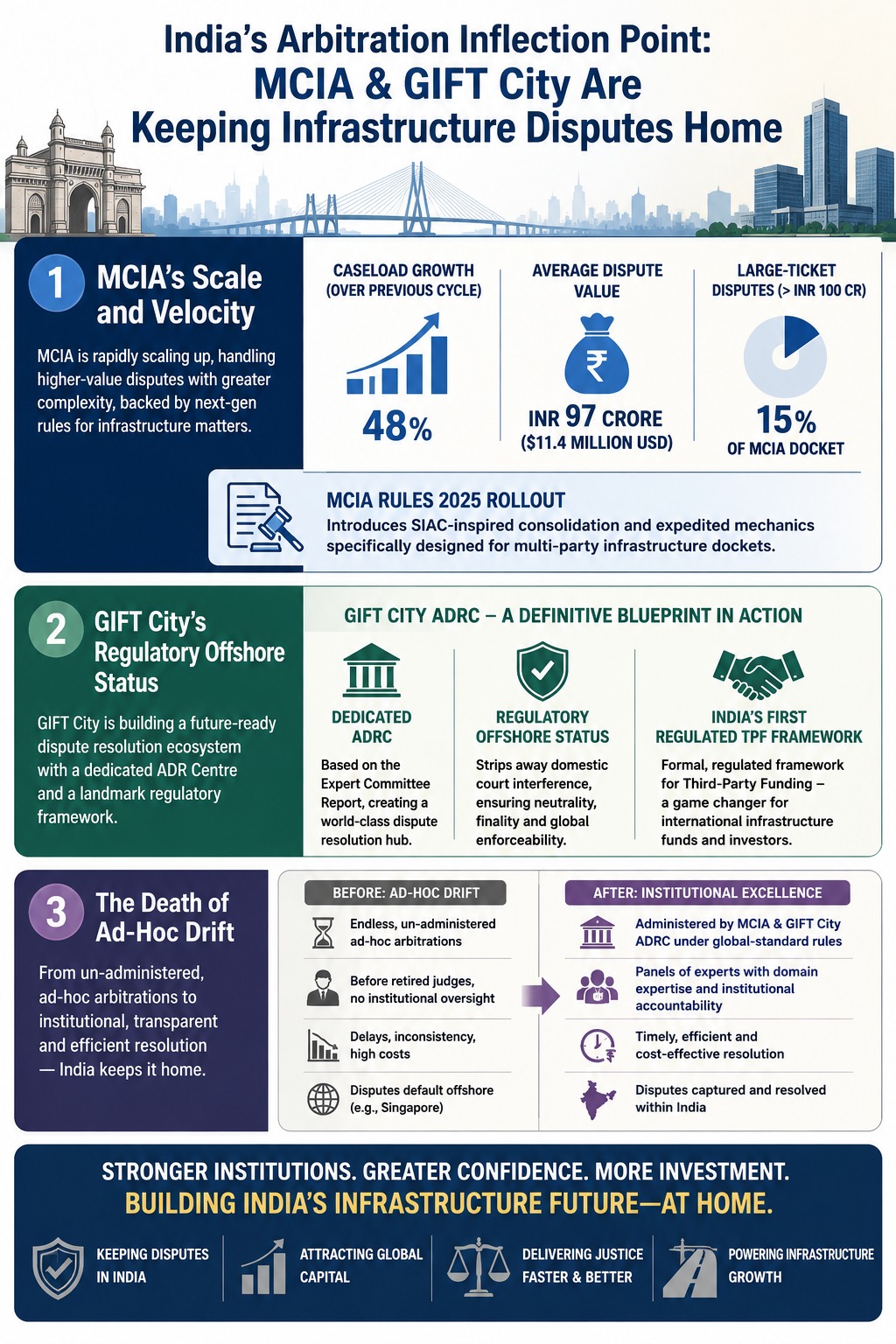
The work the rules unlock is concentrated, not peripheral, and it is being captured onshore. For large Indian infrastructure, construction and energy companies, the prior reality was that disputes were run as domestic ad-hoc arbitration before panels of retired judges. The Mumbai Centre for International Arbitration (MCIA) and the proposed GIFT City centre are institutionalising that domestic market under global-standard rules, which is precisely where a registered foreign firm can now sit.
 The trajectory is documented, and it sizes the addressable market for foreign firms:
- MCIA’s 2024 report recorded a 48% rise in new cases, to 34 matters with an aggregate value of about ₹2,180 crore (roughly $258 million) and an average value reported near $11.4 million; its 2025 report shows a further 79.5% jump, to 61 matters. The MCIA Rules 2025 saw the most substantial revision since 2016. They now add joinder and consolidation for multi-party and multi-contract proceedings, early dismissal and summary determination, and express third-party-funding provisions: machinery built for exactly the multi-party infrastructure docket.
- In parallel, the IFSCA expert committee report of July 2024 recommends a dedicated GIFT City dispute-resolution centre with a statutory carveout from ordinary court interference, statutory recognition of third-party funding, and foreign-lawyer representation. It is a blueprint still pending the legislation it requires, but it is aimed squarely at offshore-grade international arbitration seated on Indian soil.
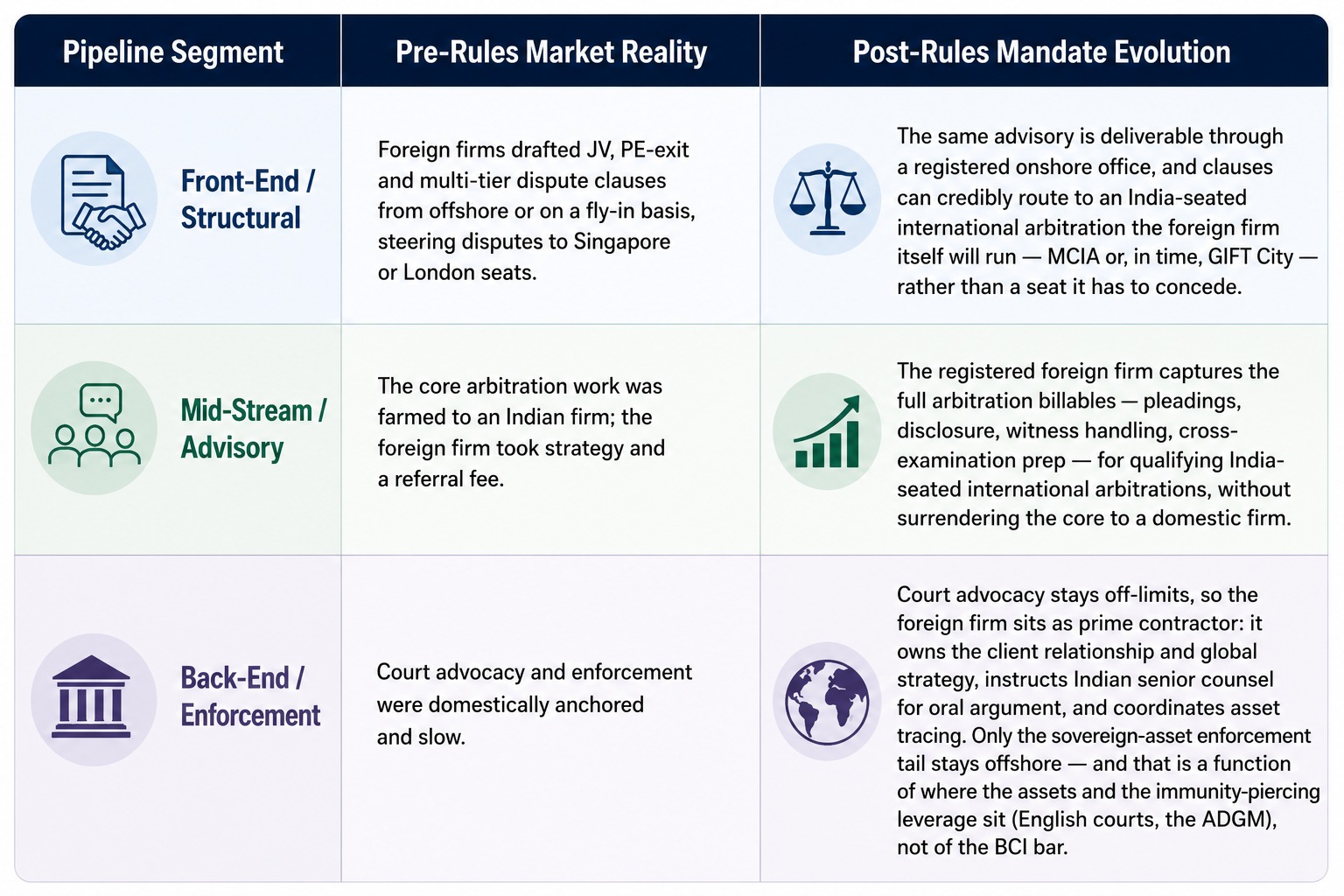
This is where corridor legal market intelligence matters. The India-Singapore legal corridor, the India-UK legal corridor and the India-UAE legal market now turn on enforcement and seat negotiation rather than on whether a foreign firm can be in the room. The sectors that generate cross-border legal work in India define the demand. So, construction and EPC arbitration, energy and project disputes, private-equity and joint-venture breakdowns, and the cross-border edges of IBC proceedings are leading the pipeline generation. The margin sits before and alongside any hearing, in pleadings, disclosure, witness preparation, cross-examination and global strategy. The rules place a registered foreign firm inside those phases for qualifying India-seated arbitrations.
The Mandate Pipeline Matrix: How Cross-Border Mandates Are Now Instructed
Cross-border mandate formation in India is shifting with the rules. The question of who instructs foreign counsel on India transactions and disputes, and at which point in the lifecycle, is what the matrix below tracks.
Competitive Playbook: The India Cross-Border Legal Market Competitive Landscape
Reading the India cross-border legal market competitive landscape starts with the legacy model. Shut out of onshore presence for three decades by the A.K. Balaji line, the global elite captured India-linked work from London, Singapore and Dubai through two structures:
- The first was the offshore disputes prime-contractor: Herbert Smith Freehills built a dominant India arbitration group run out of London and Singapore, drafting strategy and managing disclosure offshore while instructing Indian senior counsel for the domestic court steps.
- The second was the Magic Circle “best friends” network, with Linklaters, Clifford Chance and Freshfields routing big-ticket M&A and capital-markets work through AZB, the Amarchand firms and Khaitan on a fly-in basis.
- US transactional houses (Baker McKenzie, White & Case, Latham, Skadden) ran high-volume cross-border, project-finance and private-equity flows from centralised global platforms. These remain the foreign law firms whose India ranked practices set the benchmark.
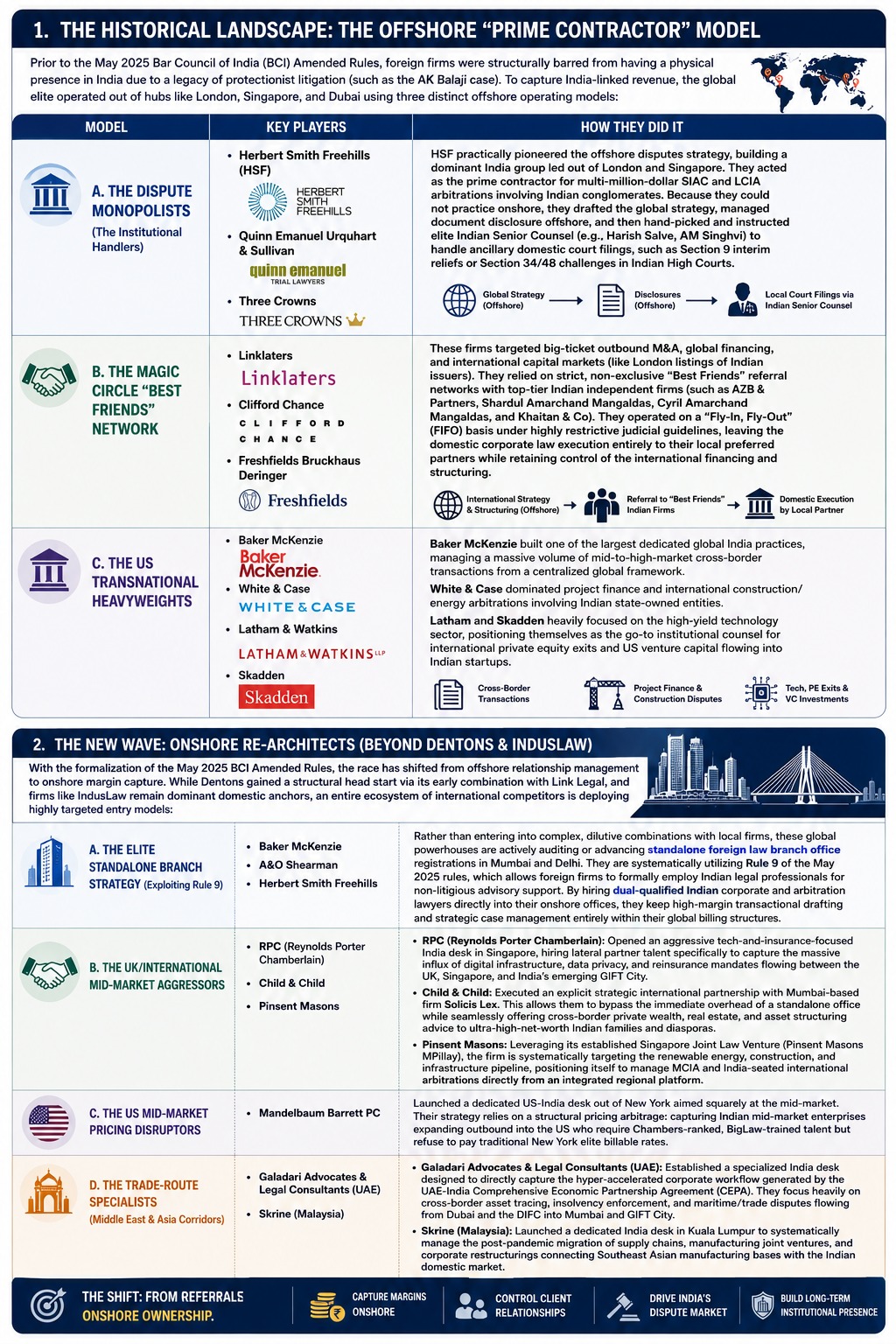
The May 2025 rules shift the contest from offshore relationship management to onshore market entry, and the early moves show both the routes and the regulator’s response:
- Dentons moved first, combining with Link Legal into a brand-sharing platform that remains Indian-owned and managed;
- CMS followed with an exclusive member-firm arrangement with IndusLaw.
Both are now contested. The BCI issued show-cause notices over alleged unauthorised collaboration, and both have challenged the rules in the Delhi High Court as ultra vires the Advocates Act. The standalone-branch route is the alternative, with Baker McKenzie stating publicly that it intends to open an India office at the earliest opportunity; others are positioned but still weighing the move.
The branch route carries a structural constraint worth getting right. A registered foreign branch can engage Indian advocates as employees, consultants or associates for foreign-law support (Rule 9(vi)), and an Indian advocate sitting as partner or associate in that branch is confined to non-litigious foreign and international law work (Rule 8(3)). What the pure foreign branch cannot do is fold an Indian-law-practising advocate in as an equity partner. Full dual practice, i.e. Indian law and litigation alongside foreign-law advisory, runs through a dual-qualified, separately registered lawyer or the new Indian-Foreign Law Firm (IFLF) category, the May 2025 vehicle built for Indian-foreign joint ventures. The IFLF and dual-qualification are the sanctioned routes; an unregistered integration marketed as a single platform is what the BCI’s 21 October 2025 release flags – which is why the Dentons Link Legal and CMS-IndusLaw combinations are in court.
Beneath the elite, a corridor-desk pattern is forming, much of it built on lateral partner moves into India practices: mid-market UK, US and regional firms are launching India desks in Singapore, Dubai and Kuala Lumpur to capture specific bilateral flows including UAE-India CEPA disputes, Southeast Asian supply-chain joint ventures, and US mid-market outbound expansion priced below New York elite rates.
The gap the incumbents leave open is a failure of structural arbitrage: the offshore fly-in model is now capped at 60 days a year against a client-disclosing Form C declaration for every visit, which makes it uneconomic for the document-heavy arbitrations migrating onshore and shifts the high-margin engine-room work to whoever registers (the economics are set out in our piece: The 60-Day Ceiling). The winning play is shifting: From servicing India from London or Singapore, it is moving toward anchoring onshore before the pipeline crowds, because registration, not relationship, is now the scarce asset.
The Strategic Signal: Positioning, Rankings and Lateral Moves
Lawfinity’s Insight:
- Treat the May 2025 rules as a codification of the profitable slices, not a half-open door, and build the business case for India market entry around the margin rather than the flag.
- Align the next Chambers Asia Pacific India rankings and Legal 500 India corridor submissions to India-seated international arbitration in construction, energy and infrastructure, rather than to generic “India Desk” presence. These are the disputes actually migrating from ad-hoc panels into MCIA and, ahead, GIFT City, how foreign firms now get ranked in the India legal market and how the credibility signals that win instructions are read.
- Register early, decide whether the practice-development proposal calls for an India desk head in Singapore or an onshore Mumbai bench, and choose the integration vehicle deliberately: employees and associates for foreign-law support, and the IFLF or a dual-qualified hire where Indian-law capability has to sit inside the structure.
The unit of analysis is the margin slice and its timing, not the courtroom. The firm that says “we run the India-seated arbitration and instruct on the rest” will hold the mandate; the firm still asking whether it can appear in the Madras High Court has misread which question the market is paying for.