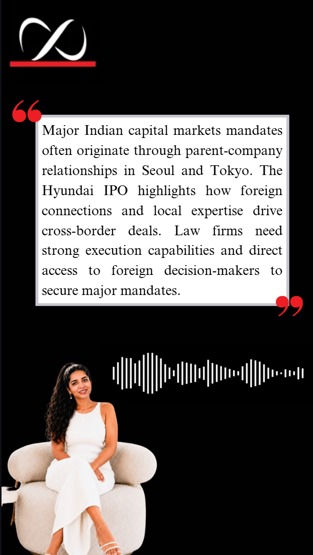
Latham & Watkins acted as international legal counsel on Hyundai Motor India’s $3.3 billion initial public offering in October 2024. It was the largest IPO in Indian corporate history and the second-largest globally that year. Its client was not Hyundai Motor India; it was Hyundai Motor Company, the South Korean parent entity. The cross-border team was led by Steve Kang in Hong Kong, Rajiv Gupta (who heads Latham’s India practice) in Singapore, and Diona Park in the firm’s Seoul office.
No part of that primary origination happened in India. The underlying assets were Indian, the listing exchanges were domestic, and the regulator was SEBI. Yet the mandate was sequenced by a corporate legal department in Seoul and awarded to a global firm that had established a physical Seoul presence in 2016.
This dynamic reveals an operational reality of the cross-border market: Latham succeeded because it held both halves of the corridor. The South Korean parent relationship sequenced the instruction, while the Singapore-based India practice executed it. For international practice leaders, that is a crucial distinction. India capability is necessary, but not sufficient. A firm holding only the India-facing relationship is structurally second to the firm holding the parent at home.
The Sequence of an Inbound Mandate
For international law firms, mega-cap inbound India instructions arrive through global parent relationships rather than local subsidiary pitches. Hyundai Motor Company was an established Latham client in South Korea. When the parent board elected to list its Indian subsidiary, the instruction moved along an existing institutional line.
This structural sequence dictates how cross-border mandates are won. A firm organised strictly around destination coverage with an India desk or regional practice group, competes for instructions after the decision to list has reached the Indian subsidiary. A firm organised around parent-jurisdiction coverage competes before India is formally on the agenda.
Latham’s Seoul office opened in 2016 under the leadership of its Tokyo managing partner, focusing on energy, infrastructure, M&A, and capital markets. While the office carried no explicit India brief at launch, its physical presence in Seoul proved load-bearing on the largest Indian equity capital markets mandate on record.
Deal Scale and the 10b-5 Threshold
A review of Indian listings by South Korean parent companies illustrates how legal advisory line-ups evolve as transaction scale increases:
- JNK India (April 2024 – INR 650 crore / ~$78 million): Shardul Amarchand Mangaldas (SAM) advised the issuer, Trilegal represented the book-running lead managers (BRLMs), and Khaitan & Co advised the selling shareholders (including South Korea’s JNK Global). No international legal counsel was named, as the transaction size was below the threshold that typically brings an offshore institutional tranche.
- LG Electronics India (October 2025 – $1.3 billion): SAM advised LG Electronics India, Cyril Amarchand Mangaldas (CAM) advised the BRLMs, and Latham & Watkins acted as international counsel to the parent.
- Hyundai Motor India (October 2024 – $3.3 billion): SAM advised both the parent selling shareholder and the Indian issuer, CAM advised the BRLMs, Latham & Watkins advised the parent, and White & Case acted as international counsel to the BRLMs out of London and Singapore.
International counsel enters at scale not because of a statutory requirement, but because mega-listings incorporate a Rule 144A institutional tranche targeted at US institutional investors. Underwriters require US counsel to provide a 10b-5 negative assurance statement to support their due diligence defense under Sections 11 and 12 of the US Securities Act of 1933. At $78 million, the advisory work remains entirely domestic. At $3.3 billion, four law firms are instructed across multiple jurisdictions, while no foreign firm maintains an office in India.
Domestic Law Firms Building Origin Coverage
The more instructive detail in the Hyundai line-up is that SAM advised Hyundai Motor Company alongside the Indian subsidiary. The domestic firm established a direct relationship with the South Korean parent, rather than limiting its coverage to local management.
SAM lead partner Sayantan Dutta noted that the LG Electronics transaction represented the firm’s third major listing for a South Korean parent, following JNK India and Hyundai Motor India. On the BRLM side, CAM partner Gokul Rajan similarly appeared across the LG and Hyundai advisory teams.
While international law firms marketed their India capabilities from regional hubs like Singapore and London, top-tier Indian firms actively built repeat instructions with corporate legal departments in Seoul and Tokyo.
The Japanese Corridor Baseline
This pattern extends beyond South Korea. When Mizuho Securities agreed to acquire a reported 60 per cent stake in Avendus Capital in December 2025 (valuing the firm at a reported $523 million), Nishimura & Asahi advised Mizuho Financial Group, while Simpson Thacher & Bartlett advised the selling KKR affiliate. The Japanese acquirer of an Indian financial services platform relied on its primary domestic counsel.
Firms like Mori Hamada & Matsumoto and Nishimura & Asahi serve as the established institutional gateway for Japan-India transactions. These are not dedicated “India practices”; they are home-jurisdiction platforms whose domestic clients are deploying capital into India.
The institution holding the foreign parent’s corporate legal relationship at home retains the inbound India mandate. Whether that firm is American, Japanese, or South Korean depends on which platform secured the parent relationship first.
Managing the Two Halves of the Corridor
Evaluating an India practice purely by regional marketing metrics or desk activity misses how major inbound mandates are actually won. An India desk can run a full program of business development, cultivate local referral networks, and publish on regulatory updates, yet remain absent from the sequence that produces a landmark listing.
Holding both halves of the corridor is what secures the work: local India expertise is essential for execution, but parent-jurisdiction coverage is what secures the instruction in the boardroom. The international firms capturing these mandates are not necessarily those with the largest India-facing marketing budgets. They are the firms that have recall in the boardroom where foreign capital is first allocated.
Lawfinity Solutions advises international law firms on cross-border legal market positioning. If the India corridor is a live question for your firm, we would be interested in a conversation. Lawfinity works with one firm per jurisdiction. Engagements begin with a single conversation about your firm’s current position and where the corridor question is live for you. Write to Prachi Shrivastava