
Watch in one-minute-video here.
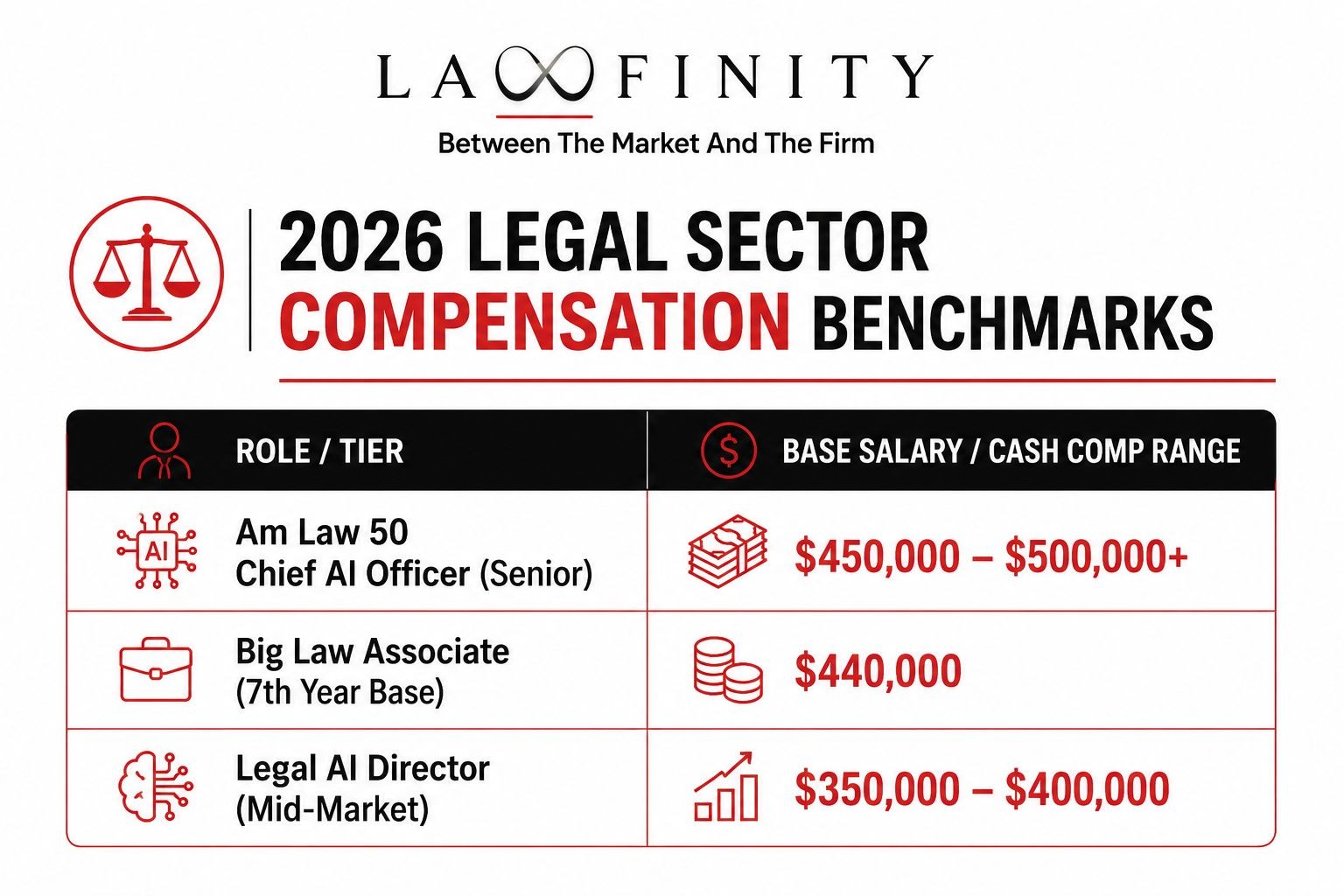
Recent compensation data across the Am Law 50 highlights a sharp spike in specialised executive overhead: the newly minted class of “Chief AI Officers” (CAIOs) and “Directors of Legal AI Innovation.”
Base salaries for these non-revenue-producing leadership roles are tracking at a market premium, consistently commanding between $350,000 and $450,000, with senior-end outliers clearing $500,000 total cash compensation. To contextualise this layout, an enterprise CAIO’s base directly rivals the newly enacted July 2026 Milbank/Cravath associate scale, where a 7th-year senior associate commands a base of $440,000.
What is interesting from an operational management standpoint is not the headline capital expenditure, but the variance between technical capability and core job mandates. Granular parsing of active executive search specifications shows that hard technical proficiencies, such as custom LLM architecture design, Python-based pipeline development, or API infrastructure configuration, sit well down the lower quartile of heavily weighted competencies.
Instead, the primary deliverables expected to justify this executive allocation are heavily indexed on non-technical, human-centric metrics:
● Stakeholder Persuasion & Consensus Building: Neutralising structural inertia among equity partners who fear margin dilution or structural disruption to billable-hour economics.
● Systemic Change Management: Overseeing the rollout of enterprise legal tech (e.g., Harvey, CoCounsel, or Microsoft Copilot integrations) across practice groups without lowering utilisation rates.
● Mitigating “Shadow AI” Deployments: Protecting firm liability by formalising
data-governance guardrails for standard practice groups while maintaining user trust.
Firms are not wrong to pay heavily for this skillset. If anything, the willingness to price strategic judgment and political influence this highly is a structural acknowledgment of a long-standing operational reality: the bottleneck to legal tech ROI is rarely the capability of the software, but the compliance and adoption curve of the partnership.
A Parallel Worth Drawing, Gently
International law firms evaluating geographical expansion or corridor-specific entry, most notably into the highly complex, volatile India corridor, face a nearly identical resourcing dilemma.
Historically, firms looking to institutionalise their India practices have defaulted to a heavy infrastructure model: onboarding a dedicated lateral partner, establishing regional desk head counts in London, Singapore, or Dubai, and funding continuous regional marketing campaigns. According to cross-border lateral market metrics, the true economic cost of a dedicated, high-caliber international partner running an internal India corridor desk looks like this:
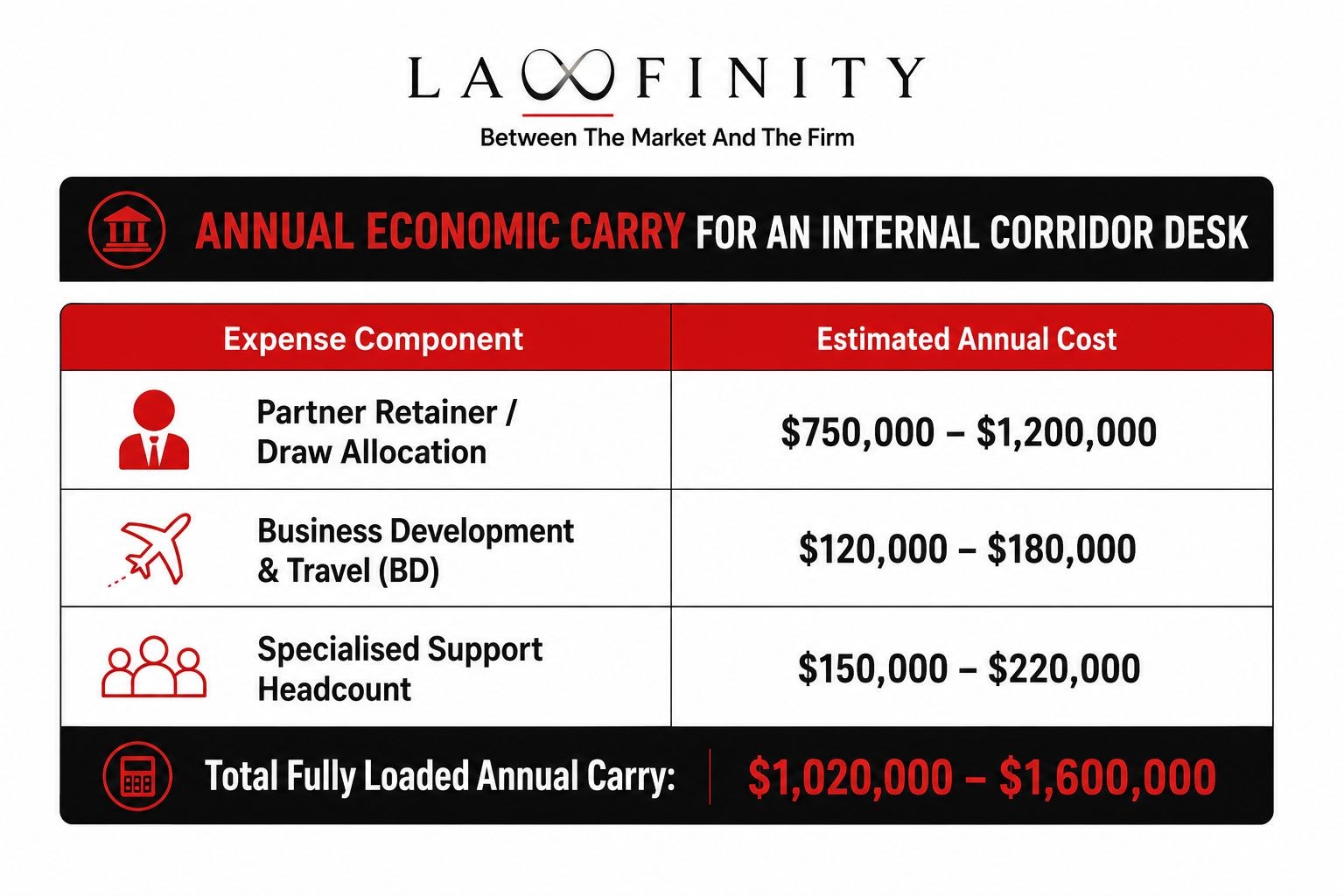
Given this capital allocation, firm leadership must distinguish between two distinctly different operational stages: market intelligence/judgment work versus technical execution/delivery work.
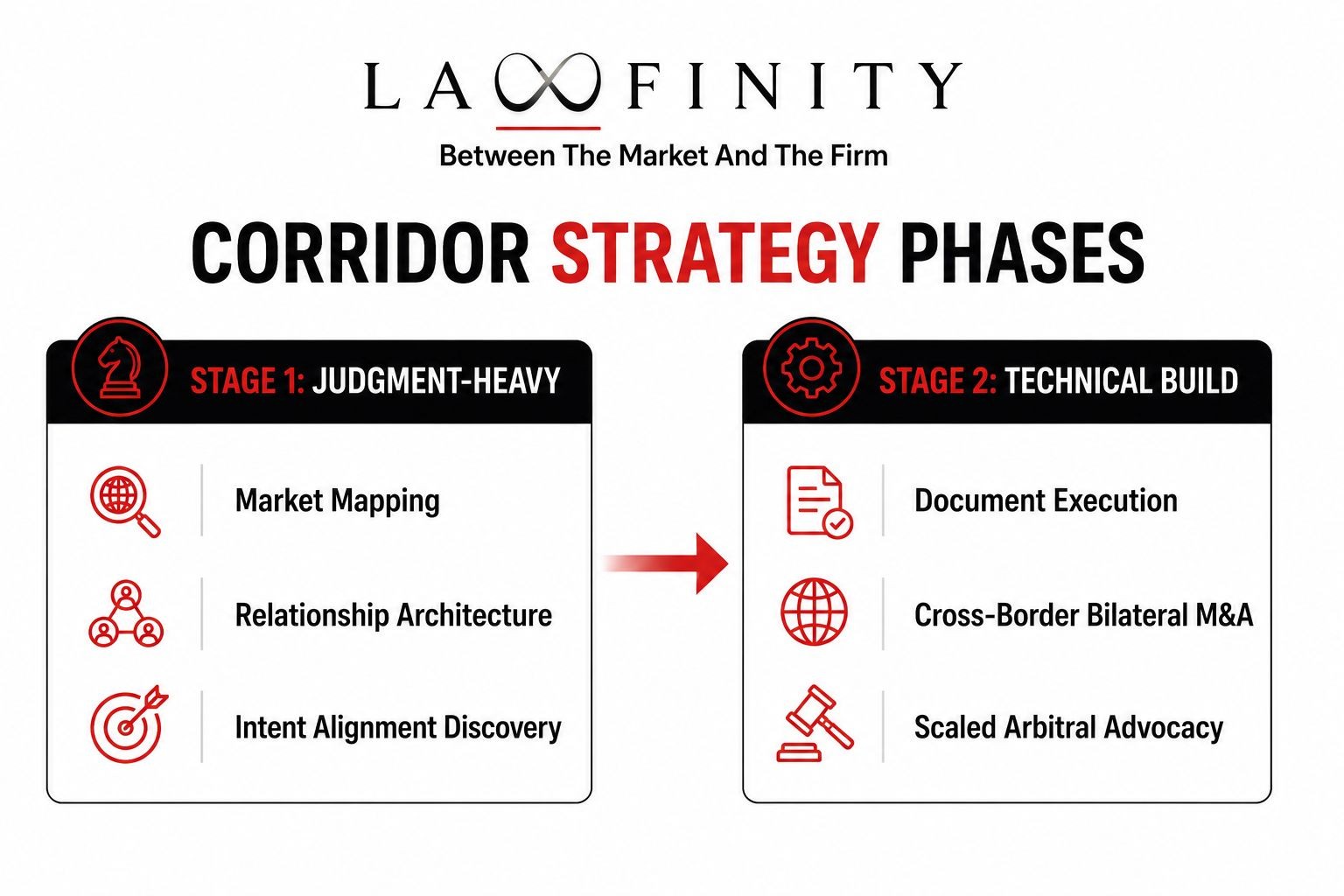
Reading which relationships are worth building, assessing which Indian conglomerates or promoters have genuine cross-border mandates, and precisely positioning a firm’s specific practice strengths against incumbents who have dominated the market for twenty years is judgment-heavy work. Conversely, once a mandate is won, drafting the joint-venture agreements, managing international project finance structures, or running a multi-million-dollar SIAC arbitration is technical execution.
The strategic misstep many firms make is conflating the two. They hire for the “technical build” from day one, absorbing massive fixed-cost overheads, before the “judgment-heavy” phase has actually mapped out a reliable, long-term pipeline of reachable revenue.
The Question This Leaves Open
The emergence of high-value AI leadership compensation structures is a definitive, data-backed acknowledgment of work that has historically been classified as an unquantifiable “soft skill”: reading a room, engineering partner alignment, and systematically translating raw capability into practical billable adoption.
For firm leadership assessing a new strategic direction, whether that means scaling up an AI governance framework or initiating a multi-year market-entry play in a critical emerging market, the dilemma is no longer whether this capability demands serious capital investment. Clearly, the market dictates that it does.
The real structural inquiry for a managing partner or executive committee is one of timing and delivery format:
At what point in the growth cycle is a firm best served by bringing this expertise in-house as a fixed overhead expense, and what alternative, fractional, or advisory mechanisms exist to deploy that exact same caliber of strategic intelligence earlier, long before the pipeline can structurally justify a million-dollar internal seat?