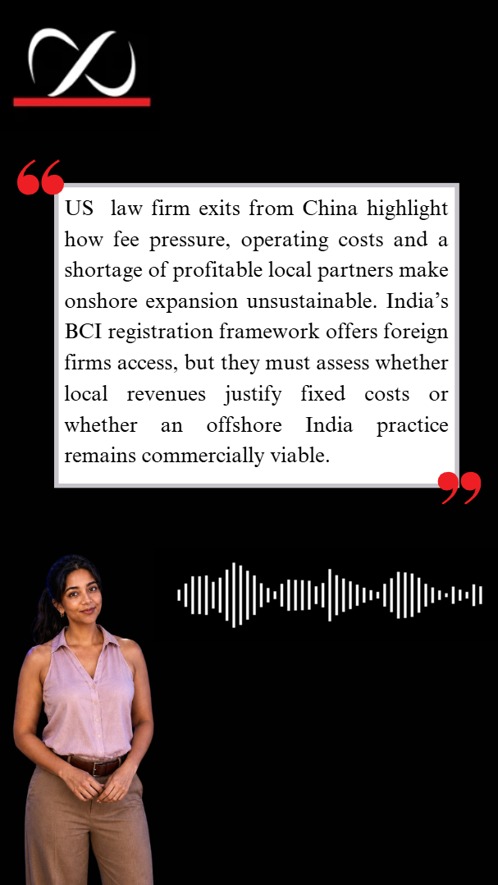
At least thirteen prominent US law firms have closed or significantly downsized their Greater China offices since June 2023. The unravelling became visible when Proskauer Rose closed its Beijing office after twelve years; Latham & Watkins and Winston & Strawn followed with office closures, Eversheds Sutherland announced plans to exit Beijing, and Linklaters, Ropes & Gray, and Baker McKenzie trimmed their local teams.
Ministry of Justice figures show the decline began in 2017 when overseas and Hong Kong firm representative offices stood at 244. Across the 2019-2021 period, the count dropped 8 per cent, falling from 225 to 208, hit a low in 2022, and recovered only to 2021 levels after a three-firm uptick in 2023. Beijing currently hosts 89 representative offices established by overseas and Hong Kong firms of which 40 belong to US practices, with a similar distribution in Shanghai.
India’s count of onshore foreign law firm offices has never fallen because, under Bar Council of India (BCI) rules, it was never permitted to rise. For thirty years since the Lawyers Collective litigation first challenged foreign firm liaison offices in 1995, international firm leadership treated this prohibition as the primary structural drawback of the Indian legal market. The China exit data suggests it should be re-evaluated as an accidental regulatory hedge: a constraint that prevented international firms from making fixed-cost onshore commitments that are now being written down next door.
The Underlying Economic Constraint
While public commentary attributes law firm departures from China to geopolitical friction and data regulation, firm leaders cite an underlying economic reality: fee compression and the scarcity of profitable local partners.
“If law firms offer the same services in the US and China, the fees in China are lower and the profit margin isn’t able to sustain operations,” notes Tom Chau, former Herbert Smith Freehills Beijing managing partner and now a Hong Kong-based partner at Haiwen & Partners, quoted on Law.asia. “Therefore, managing partners will consider leaving this market and focusing on another.” Chinese corporate clients in capital markets and advisory matters, Chau adds, remain far more fee-sensitive than European or American clients.
An anonymous partner quoted in the same report identifies the operational threshold for maintaining an onshore branch: “I would say you have a demonstrable book of business in excess of USD 1 million in revenue a year. That’s not big, just okay. There are not a lot of candidates out there that fit that bill.”
This reveals the primary constraint on foreign firm expansion: an onshore office is a bet on the local lateral partner market rather than overall client transaction volume. China’s legal market was never small, but local partners carrying a transferable book of business that clears US overhead thresholds proved exceptionally scarce. A firm that cannot recruit partners meeting that revenue threshold owns an onshore platform that cannot cover its fixed costs, regardless of gross deal volume.
Reversible Positions vs. Deep Institutional Commitment
The speed of the China pullback illustrates the nature of the original commitment. Foreign law firms can unwind a mainland representative office in two to three months if management concludes that deal flow will not recover in the medium term.
A two-to-three-month exit timeline reflects a leased office and a small group of secondees rather than a deep institutional commitment. The onshore presence for many international firms was a reversible position and it was one that their managements have now elected to reverse.
Conversely, foreign firms expanding or maintaining their presence are those with diversified practice offerings and structural integration. Baker McKenzie became the first foreign firm to establish an approved joint operation partnership with a PRC firm FenXun Partners in 2015, maintaining around thirty lawyers in Shanghai. That represents a distinct institutional commitment, and it remains the minority model.
The Indian Regulatory Framework as an Accidental Hedge
An India practice operated remotely out of Singapore, London, Hong Kong, or Dubai carries none of the fixed-cost liabilities that burdened mainland China offices.
It requires no local office lease, incurs no onshore administrative overhead, and avoids the need to recruit local partners carrying $1 million transferable books. It operates without a local regulator holding discretionary licensing authority over a physical office. Because fee-earners are deployed across multiple regional desks, an India market slowdown reduces capacity utilisation rather than stranding a localised office platform.
This structure was not chosen voluntarily by international strategy committees; it was dictated by the BCI’s historical prohibition on foreign law offices. However, that restriction preserved the exact strategic flexibility that departing firms in China are currently spending capital to recover.
Evaluating BCI Registration Against Onshore Economics
The BCI’s revised foreign firm registration framework now provides a formal route onshore: a five-year renewable registration subject to application fees, financial guarantees, and process charges, permitting a physical office for non-litigious foreign law practice, subject to reciprocity cancellation rules.
The invitation to register asks international firms to assume an onshore fixed-cost structure in a market where the lateral partner constraint is even tighter than in China. Top-tier Indian law firms operate at a Revenue Per Lawyer (RPL) band between $60,000 and $180,000. An Indian partner holding a personal, transferable book clearing $1 million represents a significant share of a mid-sized Indian corporate practice’s entire revenue. Such partners are exceptionally rare.
This does not suggest international firms should avoid registration entirely. Firms with a genuine strategic commitment and a diversified offering can support an onshore office. However, we must remember that the onshore model being introduced in India mirrors the fixed-cost structure currently being dismantled across Greater China, driven by the same unit-economic constraints.
Strategic Questions for Global Law Firms
Debates regarding law firm expansion into India traditionally focus on regulatory access:
- Whether the BCI will expand permissions?
- How will reciprocity be applied?
- When will full market entry occur?
The China exit data suggests that foreign law firms should evaluate an internal operational question instead:
What specific market conditions make an onshore India office a different economic proposition from the China office this firm recently closed or downsized?
Gross market size does not answer the question, as China’s market volume was never the limiting factor. Client demand alone is insufficient, as fee pressure exists in both jurisdictions. The answer depends on the local partner market: whether the firm can recruit lateral partners with transferable books that clear international profit thresholds, and whether management is prepared to subsidize an onshore presence until those partners are secured.
Firms that can clear that lateral partner threshold should proceed with BCI registration. A firm that cannot, has already been running the right offshore desk strategy for two decades since regional hubs built out dedicated India practice groups in the mid-2000s. The commercial case for changing that posture remains unproven.
Lawfinity Solutions advises international law firms on cross-border legal market positioning. If the India corridor is a live question for your firm, we would be interested in a conversation. Lawfinity works with one firm per jurisdiction. Engagements begin with a single conversation about your firm’s current position and where the corridor question is live for you. Write to Prachi Shrivastava