
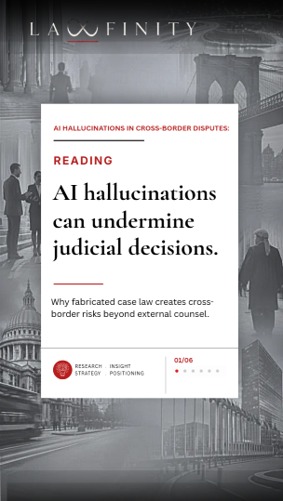
On 2 July 2026, the Supreme Court of India set aside an NCLT order and the NCLAT judgment affirming it because the tribunal’s order rested on six judicial authorities it had not been given. Three of the cited judgments do not exist while the others were attributed paragraphs that appear nowhere in the genuine records.
The bank stated in its affidavit that its counsel had never cited those authorities. The tribunal had retrieved them through its own internal research.
The original order admitted a Section 7 insolvency application against Essel Infraprojects as corporate guarantor on 28 August 2024. The NCLAT dismissed the appeal on 11 September 2025. The admission stood for twenty-two months, with the statutory Section 14 moratorium running, before the Supreme Court held in Pooja Ramesh Singh v. J&K Bank that a decision resting on fabricated material is “no decision in the eyes of the law” and must be set aside regardless of whether that material affected the ultimate commercial outcome.
For cross-border commercial parties, this represents the first AI failure on the India corridor that destroyed measurable value. It is also a risk that no client engagement letter, AI-use disclosure, or law firm indemnity could have prevented, because the exposure did not originate with external counsel.
The Governance Conversation Targets External Counsel
Most governance discussion regarding artificial intelligence focuses on law firm practice: whether fee-earners verify output, whether AI use is disclosed to clients, and whether proprietary data enters public models. General counsel have articulated clear expectations on these points.
Client expectations are already specific. At a minimum, companies expect data security, transparency, disclosure and verification from external counsel. Some go further and ask which model is in use, so that their own data science teams can clear it on safety and accuracy grounds.
These demands address the party exercising commercial judgement. However, in Pooja Ramesh Singh, external counsel committed no procedural error. The error was at the adjudicating tribunal’s end.
Regulatory Divergence Across Regional Hubs
The duty to disclose AI usage lacks a uniform standard across major Asian legal hubs, complicating cross-border transaction management:
- Singapore: The Ministry of Law published its Guide for Using Generative AI in the Legal Sector on 6 March 2026. Being express non-binding in nature, it advises practitioners to consider disclosing generative AI usage when it is substantial, impacts billing, or where data handling may conflict with client preferences or data residency requirements. It recommends addressing AI protocols in engagement letters and offering client opt-out mechanisms.
- India: The Bar Council of India (BCI) has issued no rules or guidance on AI competence, disclosure, or verification. In Pooja Ramesh Singh, the Supreme Court directed the BCI to constitute a committee to prescribe disciplinary rules for citing unverified AI case law. That regulatory framework remains pending.
- Japan & South Korea: In Japan, Hideyuki Sakamoto, Chief Legal Officer of Gibraltar Life Insurance and President of the Japan In-House Lawyers Association, observes no ethical requirement to disclose AI tool usage to clients, noting that firms have used digital research tools for years without separate disclosure. Sakamoto expects verification rather than disclosure. In South Korea, Hee Woong Yoon, Co-Managing Partner at Yulchon, treats transparency as an ethical consideration rather than an explicit regulatory obligation.
Asking whether counsel must disclose AI usage yields a non-binding guide in Singapore, a pending committee in India, an absence of explicit rules in Japan, and an ethical consideration in South Korea.
Governance Standards Travel with International Clients
Client procurement terms, rather than local bar rules, fill this regulatory vacuum.
Hiroo Atsumi, Managing Partner of Atsumi & Sakai in Tokyo, notes that his firm receives written requests from global acquirers demanding assurances that strict confidentiality is maintained when deploying AI tools for due diligence. In a jurisdiction where the local in-house association recognises no formal disclosure duty, these undertakings are imported by international corporate buyers enforcing their home governance standards.
When a General Counsel imposes an AI governance clause on lead counsel, that standard applies to the primary instruction. It rarely descends to local counsel managing domestic execution.
The structure is routine. On Marvell Technology’s acquisition of Celestial AI, Wilson Sonsini acted for Marvell, Latham & Watkins for Celestial AI, and JSA handled the India leg which included the transfer of employees and assets to Marvell India, the restatement of the LLP agreement and the regulatory filings. The most sensitive data on that leg was employee data, and it sat with the firm furthest from the engagement letter that set the standard.
Procurement Criteria and Law Firm Economics
When client AI requirements harden into conditions of instruction, they function as procurement criteria that select for institutional capability rather than legal quality.
In my understanding, the larger sample of Indian law firms are not yet actively deploying AI tools in daily practice, but increasingly recognise the need to catch up following the BCI framework permitting foreign lawyers and law firms to register in India. Active AI adoption by foreign firms is creating the pressure that Indian firms need to embrace the technology.
Meeting corporate AI standards such as identifying specific models, evidencing safety controls, and satisfying client data science audits requires enterprise-tier licensing, security reviews, vendor negotiations, and dedicated risk personnel. None of these overheads are directly billable.
This dynamic connects directly to firm unit economics. An international firm generating approximately $1.39 million in Revenue Per Lawyer (RPL) funds this non-billable compliance infrastructure out of the gap between revenue and cost. An Indian firm operating at an RPL around $170,000 must absorb those same requirements out of partner bandwidth. Global firms entering the corridor bring an AI compliance infrastructure already funded by a higher-revenue domestic market.
A procurement criterion imported by an international client filters firms based on their capacity to fund non-billable overhead. That is a factor unrelated to the substantive quality of legal advice.
Locating Enforceable Contractual Remedies
The most enforceable risk control in the legal tech stack is one the client rarely sees.
Rajah & Tann Asia recently spoke outlining the process of auditing tools such as Microsoft Copilot and Harvey to secure specific vendor indemnities and contractual warranties ensuring client data is excluded from model training.
This provides an enforceable legal remedy, but the contract runs between the law firm and the software vendor. A General Counsel reviewing an AI clause in an engagement letter receives a representation; the underlying financial recovery mechanism sits in a vendor agreement to which the client is not a party.
Evaluating Risk Across Cross-Border Mandates
Managing cross-border risk requires separating three distinct operational layers that are usually conflated. The law firm’s own verification practice is the first layer, and it is the only one tested by a client procurement standard. The vendor’s contractual terms represent the second layer, where enforceable data protection and financial recovery actually reside.
The third layer is the research practice of the forum itself, operating entirely outside the contractual reach of either party. As Pooja Ramesh Singh demonstrated through twenty-two months under moratorium, no engagement letter or vendor warranty can insulate a transaction from an adjudicator relying on hallucinated precedent.
Selecting a dispute forum or arbitral seat now requires evaluating its judicial verification standards. For a General Counsel weighing forum options on an India-facing transaction, this is a live operational input rather than a theoretical concern, marking the first time the AI question bears directly on where a dispute is heard rather than who is advising on it.
Lawfinity Solutions advises international law firms on cross-border legal market positioning. If the India corridor is a live question for your firm, we would be interested in a conversation. Lawfinity works with one firm per jurisdiction. Engagements begin with a single conversation about your firm’s current position and where the corridor question is live for you. Write to Prachi Shrivastava










