
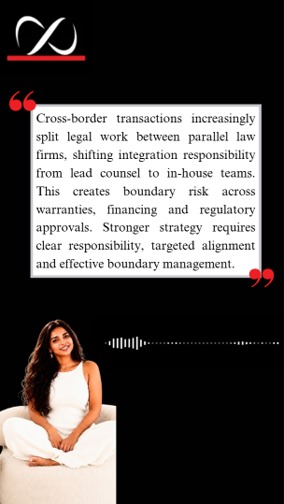
When a cross-border transaction is partitioned between two law firms instructed in parallel, each operates under a defined retainer and each is discharged on completion. What sits between those scopes is boundary risk: how one firm’s legal work interacts with the other’s.
In the historical lead-counsel model, a single international firm held that overarching responsibility. In the partitioned model now dominating inbound growth and M&A corridors, that function has migrated to the client’s in-house legal team.
This structural shift warrants careful examination by law firm management and General Counsel alike. Foreign firms are losing a revenue stream without always isolating the underlying legal function that generated it, while corporate legal departments are absorbing complex integration duties without always adjusting their resourcing.
Deconstructing the Lead Counsel Premium
The historical coordination premium charged on cross-border deals was never merely administrative. While clients were right to eliminate inflated billings for routine project scheduling, the lead counsel fee also covered systemic risk integration.
Under a unified mandate, transaction risks were evaluated holistically by a lead partner holding the entire deal structure in mind. That team ensured that local due diligence disclosures aligned with foreign-law warranty frameworks, that indemnity packages matched foreign financing covenants, and that local regulatory conditions precedent mapped cleanly onto international funding mechanics. None of these checks appeared as individual line items on a fee proposal, but together they prevented structural friction between parallel workstreams.
When corporate legal departments unbundled the mandate to strip out coordination overhead, this systemic integration was disaggregated across separate retainers.
Where Boundary Friction Manifests
Boundary risk is not an abstract concept; it surfaces at specific, recurring touchpoints in cross-border execution:
- Warranties, Disclosure Schedules, and W&I Coverage: Representations negotiated under English or Delaware law interact directly with local-law disclosure schedules. Where Warranty & Indemnity (W&I) insurance is utilised, underwriters perform a line-by-line audit comparing local due diligence findings against foreign-law warranty packages. Discrepancies between what constitutes “fair disclosure” under local practice versus the foreign governing law can leave material gaps in coverage.
- Financing CPs and Local Regulatory Outcomes: Facilities agreements drafted under English or New York law routinely condition drawdown on the satisfaction of local regulatory approvals. The international finance team drafts the condition precedent, while local counsel manages the regulatory interface. If the specific terms of the clearance granted by a local regulator do not precisely match the definition in the financing documentation, funding can be delayed at closing.
- Sequencing and Closing Mechanics: Cross-border closing protocols depend on implicit timing assumptions regarding board approvals, funds flow, regulatory effectiveness, and share transfers across jurisdictions. When parallel firms operate in silos, alignment on these mechanics can be overlooked until the eve of closing.
Evidence, Resourcing, and Market Realities
It is important to acknowledge two clear market limits to this analysis. First, interface failures are inherently difficult to demonstrate through public deal data. When boundary friction results in post-closing indemnity disputes or delayed drawdowns, the matter is framed around warranty interpretation or regulatory timing. It is rarely identified publicly as an unallocated gap between two legal retainers.
Second, many unbundled transactions close and perform entirely without difficulty. Highly sophisticated in-house teams, combined with informal collaboration between familiar law firms, frequently bridge these gaps seamlessly. The claim is not that unbundled transactions are routinely failing, but rather that accountability for boundary risk has moved. Where it remains unassigned, it is carried by default rather than by design.
Institutional private equity sponsors have adapted to this shift by expanding their internal legal departments, hiring senior M&A practitioners specifically to act as internal general contractors who actively manage workstream interfaces. However, in mid-market strategic M&A and corporate growth transactions, unbundling is frequently driven by CFO cost compression rather than deliberate operational design. In these matters, leaner in-house legal departments often absorb complex cross-border integration without dedicated resourcing, treating as a cost saving what is actually an internalised operational risk.
Strategic Positioning for Parallel Counsel
For foreign law firms, the strategic opportunity is not to pitch a redundant “interface supervision” retainer, which sophisticated GCs will reject as unbundled overhead re-packaged under a new name. Instead, foreign firms should refine how specialist scopes are framed.
When retained for specialised non-Indian law workstreams, such as foreign debt facilities, fund-level mechanics, or global restructuring foreign firms should explicitly embed cross-jurisdictional alignment protocols into their core scope. Offering targeted integration on critical boundary points, such as auditing how local regulatory outcomes map to international drawdown conditions or aligning W&I policy mechanics with local disclosure standards, presents a compelling proposition: identifiable legal risk management rather than generic process oversight.
For local firms holding the primary commercial execution mandate, holding the core deal terms puts them closest to the boundary. Identifying and flagging cross-jurisdictional inconsistencies early in the transaction is either an uncompensated risk or a valuable scope extension. Formalising boundary alignment as part of the primary execution mandate allows top-tier local firms to further consolidate their position as the lead commercial advisor on the transaction.
Aligning Strategy on Both Sides of the Corridor
As both international law firm leadership and corporate legal departments adjust to the disintermediated corridor, the central operational question is how boundary risk is priced, assigned, and managed.
For a General Counsel instructing in parallel, it means establishing whether responsibility for reading overlapping transaction documents against each other is explicitly written into an engagement letter or left to informal coordination.
For a foreign law firm, it requires recognising that defending cross-border revenue depends on moving beyond generic process management to offer tangible, high-value alignment where those legal boundaries meet. Where neither side addresses the gap explicitly, boundary risk remains an unmanaged byproduct of the unbundled deal desk.
Lawfinity Solutions advises international law firms on cross-border legal market positioning. If the India corridor is a live question for your firm, we would be interested in a conversation. Lawfinity works with one firm per jurisdiction. Engagements begin with a single conversation about your firm’s current position and where the corridor question is live for you. Write to Prachi Shrivastava










