
H-1B cap registrations by India’s six largest IT services firms fell 92 per cent for fiscal 2027, from 21,919 to 1,763. The obvious reading is a story about Indian outsourcing and US immigration policy. The wider data cuts against it. IBM’s registrations fell 95.6 per cent over the same period, Accenture’s 94 per cent, Capgemini’s 87.5 per cent, while Microsoft alone filed more registrations than all six Indian firms combined.
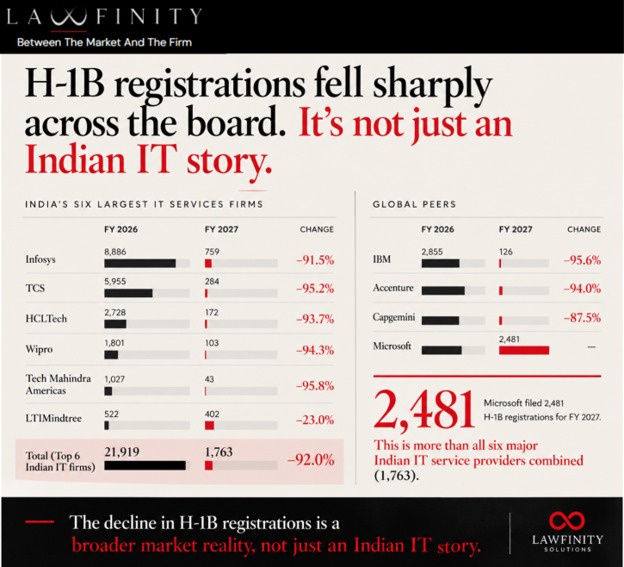
The line does not fall between Indian and Western companies. It falls between firms that sell deployed expert hours and firms that sell software products. The first group has been forced to stop moving people in volume; the second has not. That distinction matters to international law firm strategy, because law firms sit unambiguously in the first group.
The Anatomy of a Delivery Model Shock
For professional services firms, cross-border deployment supported a volume-based delivery model: deploying mid-level and junior professionals at volume to client locations, with the physical movement of expert hours serving as the core operating mechanism.
Two regulatory policy changes repriced that model simultaneously: a $100,000 fee attached to specific new petitions, extended through September 2027, and a selection lottery reweighted toward higher wage levels. These changes removed the underlying economics of moving personnel in volume.
The response from IT services leadership was not to absorb the margin hit, but to rapidly restructure delivery. Firms pivoted to local hiring, nearshore delivery hubs, and expanded offshore execution, reserving cross-border deployment strictly for high-margin, non-delegable roles. What is remarkable is the speed of execution. A cross-border delivery model that had been stable for two decades was reorganised within a single filing cycle because the underlying cost structure moved. The restructuring was forced by economics rather than designed by choice.
Where the Legal Analogy Applies
This comparison does not apply at the level of immigration law. Law firms do not deploy associates to client sites in high volumes, and short-term partner travel from Singapore, London, or New York is not threatened by work-visa fee increases.
The comparison applies directly at the level of delivery economics. A business that monetises expert hours and delivers them by flying partners across borders operates on a cost structure exposed to external pressures it does not control.
The India, Middle East, and Southeast Asia practice desks of many international law firms run on precisely this model: a small group of partners based outside the market, traveling in for client meetings and deal execution. That model is facing a commercial cost shock: clients are actively stripping out travel markups, rejecting partners billing at three to four times local partner rates for fly-in oversight, and instructing direct local partners who operate at a fraction of the cost.
The strategic question for law firm management is not whether they face a visa problem, but whether they have evaluated what their cross-border delivery model costs when clients refuse to subsidise the friction of moving people.
AI Postures: Dividing Efficiency vs. Productising the Offering
Running alongside delivery-model friction is the integration of generative AI, where professional service sectors demonstrate contrasting strategic postures.
In the legal industry, the executive discussion remains concentrated on fee-splitting and margin defense. Corporate legal departments are demanding that outside counsel pass back efficiency savings. Law firms are attempting to recover software subscriptions, implementation costs, and token usage within matter budgets. Even under fixed-fee arrangements, internal pricing estimates remain anchored in lawyer hours. This model faces friction when a task requires minimal lawyer time alongside substantial AI platform usage.
This conversation focuses primarily on how to divide efficiency savings on billable hours.
Mid-tier IT services providers have taken a different approach by productising efficiency directly:
- Hexaware’s “Zero License”: Deploys agentic AI to replace legacy software workflows, directly targeting and reducing a client’s third-party software licensing spend.
- Coforge’s “AI Launchpad”: Enables enterprise clients to build, fine-tune, and deploy custom AI tools in-house while retaining internal governance.
- LTM’s “OneToken”: Bundles access across multiple AI models under a unified subscription while actively optimizing the client’s token and cloud spend.
Each of these offerings monetises a reduction in client expenditure, and two of them deliberately reduce the client’s reliance on the vendor’s own billable headcount. This represents intentional productisation: replacing legacy service revenues with proprietary AI platforms on the vendor’s terms before a competitor or client-side tool does it on theirs.
One industry is negotiating over who retains billable efficiency savings; the other is selling efficiency as the core product.
Practice Group Vulnerabilities
The exposure across law firm practice areas varies by service type:
- Volume and Process Execution (High Risk): Document review, due diligence, routine contract drafting, and compliance monitoring face immediate productisation pressure. Alternative Legal Service Providers (ALSPs) and client-side AI tools compete directly in this space. Firms that do not convert these workflows into firm-owned tools will be priced out by competitors that have.
- Cross-Border Delivery Desks (Medium-to-High Risk): Practice groups relying on flying foreign partners into regional corridors operate on fragile cost assumptions. Where clients can access sophisticated local counsel directly, the fly-in advisory model faces rapid margin compression.
- Bespoke Commercial Advisory (Low Risk): Complex cross-border litigation, novel regulatory strategy, and high-stakes M&A structuring remain insulated. However, the risk for firms in this category is assuming that because high-end advisory is secure, the billable economics of the rest of the practice are equally protected.
Two necessary concessions when evaluating this shift
First, the H-1B comparison is an economic analogy regarding delivery models, not a prediction of legal immigration policy changes. Law firms do not face the same visa shock.
Second, the productised AI offerings cited represent recent market developments. Hexaware’s Zero License is documented through the company’s own materials, while AI Launchpad and OneToken reflect recent company announcements and press reporting. Whether productised AI solutions generate long-term subscription revenue that fully replaces displaced billable hours remains unproven, and firms adopting these strategies may destroy service margin faster than they build platform revenue.
The strategic distinction lies in the question being asked: whether a firm views AI as a tool to execute billable hours faster, or as a platform to deliver outcomes directly.
The Timing
The IT firms restructured because the cost moved and there was nothing to defend it with. Twenty years of delivery were redefined within one filing cycle, coincidentally.
So the question is:
- What would the law firm’s cross-border delivery cost if clients stopped paying for the travel and how long a local co-counselling arrangement would take to stand up?
- Whether the firm’s position on AI efficiency is a discount it intends to concede or a product it intends to sell.
Most firms have arrived at the first without ever deciding against the second, which is a choice made by default rather than one that has been taken.
Lawfinity Solutions advises international law firms on cross-border legal market positioning. If the India corridor is a live question for your firm, we would be interested in a conversation. Lawfinity works with one firm per jurisdiction. Engagements begin with a single conversation about your firm’s current position and where the corridor question is live for you. Write to Prachi Shrivastava










