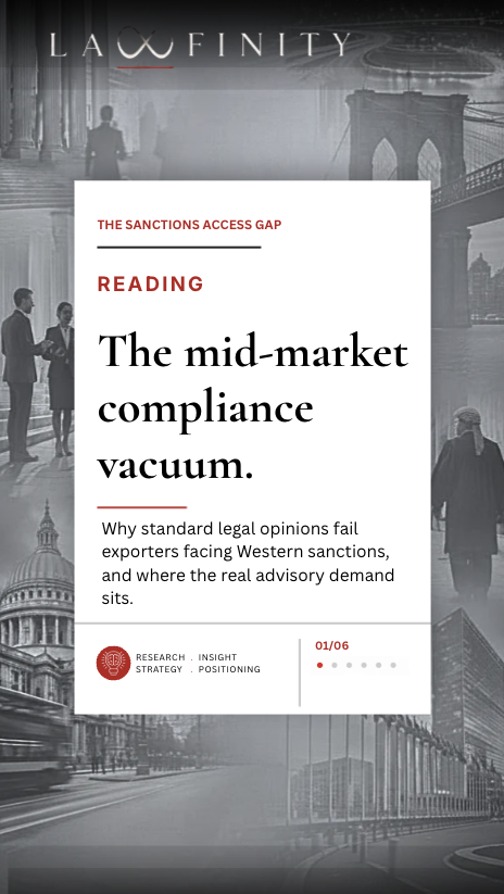
Three things happened in the same week. ONGC Videsh received OFAC clearance to resume Venezuelan operations and recover trapped dividends. Indian exporters declined the government’s rupee settlement mechanism for trade with Russia, citing secondary sanctions exposure. And the Belgian Prime Minister arrived in Delhi with the Antwerp-Surat diamond corridor on the agenda, a route that now runs through the G7 provenance regime built to exclude Russian-origin stones.
Read together, they describe a mid-market that is now inside three separate Western enforcement regimes at once, without an accessible advisor in any of them.
Domestic firms in the region cannot issue formal opinions on OFAC, OFSI or EU measures. Global firms in London and Washington configure their sanctions practices for multinationals and price mid-market transactions out.
Two constraints that defeat the obvious approach
The first is the willingness-to-pay cap. Mid-market exporters operate on tight margins and treat compliance as overhead rather than an asset. They will not fund open-ended advisory memos at international rates, and a practice built on selling them one is a practice built on a client who has already declined.
The second reason is often overlooked. A legal opinion stating that a trade is compliant does nothing if the correspondent bank’s compliance desk flags the payment. It is not legal theory that influences outcomes here, it is the bank’s internal risk appetite that is instrumental.
That second constraint changes the shape of the whole proposition. If the legal opinion does not change how the exporter acts, the exporter is not really buying an opinion. The exporter is buying leverage before the institution standing between it and settlement. The document has a purchaser, but it has a different audience, and the audience is the one with the veto.
Which means the question is not how to reach thousands of exporters at a price they will pay. It is who already carries this risk in aggregate and has a reason to want it resolved.
What the three examples actually tell you
Each of the three points at a different aggregator, and that is their value here rather than their regulatory content.
The ONGC matter is licensing work, and the buyer is a state-owned enterprise with counsel already in place. It tells you what the top of this market looks like and confirms that it is already served. It is not the opportunity; it is the benchmark against which the unserved part becomes visible.
The rupee settlement refusal is more instructive. Exporters declining a mechanism their own government is promoting is a decision taken hundreds of times inside individual companies before it surfaces as a trade story. Each of those decisions needed a view on secondary sanctions exposure, and each was taken by a company that could not commission one at international rates. Someone gave those companies comfort, or they simply declined out of caution. Both answers point somewhere: to the trade finance desks and the domestic counsel who were asked first.
The diamond corridor points at the third. Provenance regimes push the verification burden onto mid-stream processors, and Surat’s processing industry is being asked to evidence origin to a regulator it has no relationship with. That burden is identical across every processor in the corridor, which makes it the wrong problem to solve one client at a time and the right one to solve at the level of an industry association.
Where the work is bought
The buyers are the institutions that hold this risk across many transactions rather than the businesses generating them one at a time: domestic corporate firms who need an opinion they cannot give, trade finance desks who need a transaction to clear a correspondent bank’s screening, and export councils whose members all face the same verification requirement.
None of those buyers is reached by publishing sanctions alerts at exporters. They are reached individually, they buy on the basis that the risk is theirs rather than their members’, and they can pay at a level that individual exporters cannot because they are spreading the cost across a book.
Law firms may find this to be a narrower and less exciting proposition than a large unserved market. It is also the reason the market has stayed unserved:. Law firms keep pitching at the volume, whereas conversion is at a different level.
Limits of the Pipeline
The correspondent bank constraint cuts both ways, because a firm that positions itself as able to get transactions cleared is making a representation about someone else’s risk committee that it cannot control. The offer has to be about the quality of the analysis, not about the outcome at the bank.
And the aggregator route is slower than it looks. Domestic firms, trade finance desks and export councils each take a long time to appoint, and none of them will do so on the basis of published analysis alone.
Lawfinity Solutions advises international law firms on cross-border legal market positioning. If the India corridor is a live question for your firm, we would be interested in a conversation. Lawfinity works with one firm per jurisdiction. Engagements begin with a single conversation about your firm’s current position and where the corridor question is live for you. Write to Prachi Shrivastava