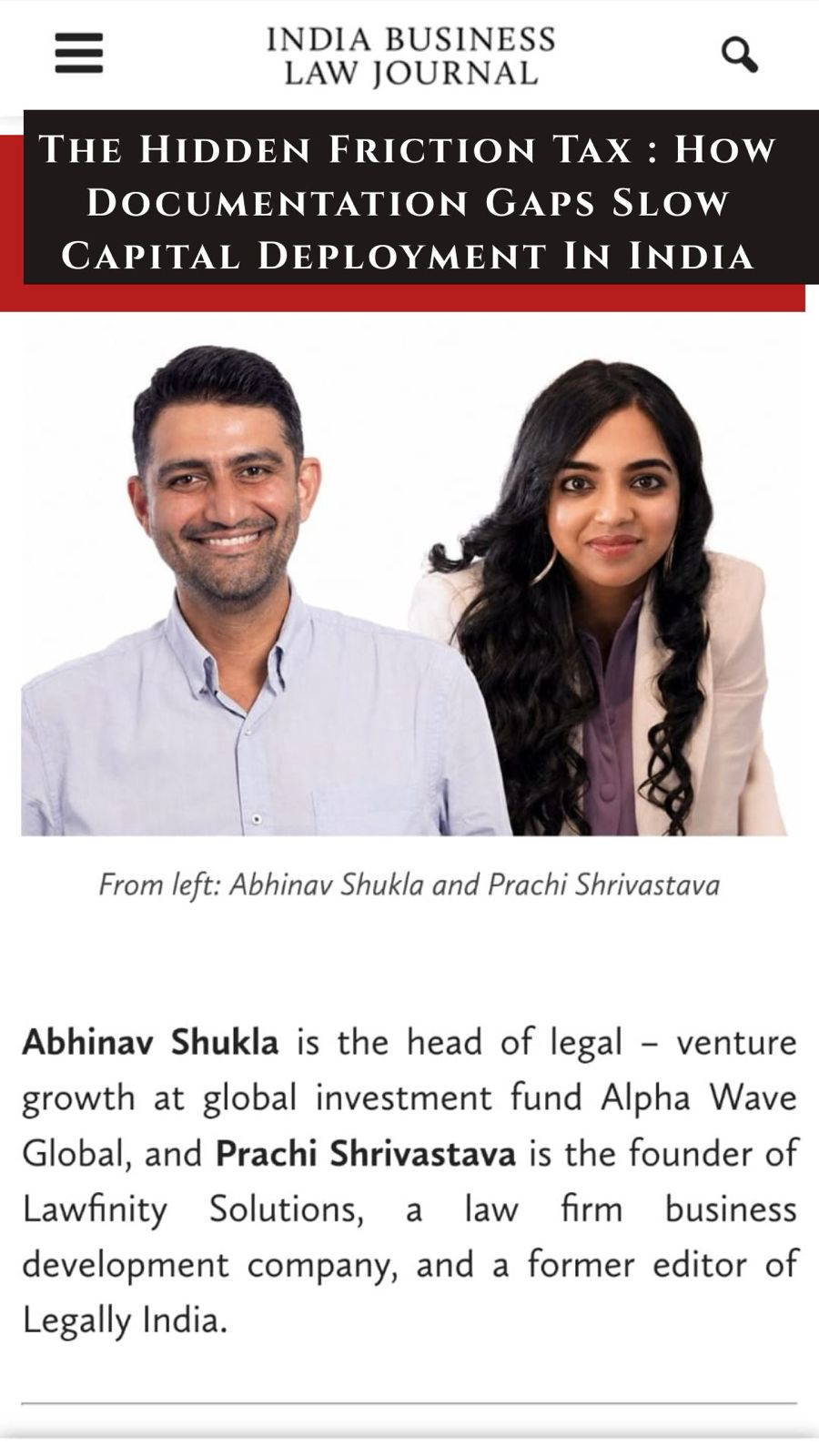
By- Prachi Shrivastava and Abhinav Shukla
This Article was first published in India Business Law Journal.
India has the ambition, the capital, and the talent. What it still lacks is the paperwork infrastructure to move fast.
Consider a thought experiment. Three early-stage companies — comparable in model, team quality, and market opportunity — are raising their first or second institutional round. One is incorporated in Delaware, one in England and Wales, and one in India. All three receive term sheets in the same week.
The Delaware company closes in under three weeks. Its investors have seen NVCA-style documents repeatedly. The cap table mechanics, liquidation preference structure, and vesting framework are known quantities. Negotiation focuses on valuation and board composition. The English company closes in four to five weeks, working from BVCA-aligned terms that both sides’ counsel recognise.. The Indian company is often still in redlines 6-8 weeks later.
This is a familiar pattern to practitioners deploying capital across these markets. And the primary driver is not that Indian lawyers are less capable, or that Indian deals are more complex. Multiple factors contribute: tax structuring complexity for cross-border funds, FEMA compliance variance, regulatory approvals, and founder entity cleanup. But even controlling for those, one structural difference persists: India lacks the shared documentation framework that serves as a recognised starting point in the US and UK.
This isn’t just about deal speed. It’s about how foreign capital perceives and allocates to Indian early-stage opportunities. When LPs evaluate emerging markets, they pattern-match on transactional infrastructure as much as company quality. Documentation friction becomes a systematic signal of ecosystem maturity—one that affects capital allocation in ways that are difficult to quantify but structurally real.
Let’s look at what this means, and what it costs.
What Standardisation Actually Means
Before addressing the gap, it is worth being precise about what standardisation does and does not mean. It does not mean identical documents. It means predictable frameworks with known variance points.
In the US, SAFE notes are standard not because every term is identical, but because the structure is familiar. Variance exists – valuation caps, discount rates, pro-rata rights — but those variance points are known. Founders understand what is being negotiated. Lawyers know what is market versus aggressive. Investment committees evaluate substance without relitigating structure. The same logic applies to NVCA model documents for priced rounds: the representations and warranty package is understood, founder indemnity norms are settled (personal indemnity by founders is not standard), and veto right conventions are established.
Notably, a standard NVCA investor does not get to unilaterally block a fundraise, provided anti-dilution protection is in place. These are not live negotiating points. They are the floor from which real negotiation begins.
Standardisation does not mean a straitjacket, however, and this is where the Indian context demands genuine thought rather than simple transplantation. A well-designed Indian standard-form document should reflect Indian commercial realities. The following examples illustrate both the gap and the opportunity.
Operational covenants: US documents run lean—investors rely on board oversight. Indian practice evolved toward granular covenants, reflecting governance concerns where board oversight has been less reliable. A standard Indian form should protect investors without hampering founder speed. For example, NVCA model documents present reserved matters lists that are deliberately constrained -: protecting investor economics (anti-dilution, liquidation preference, fundamental capital structure changes) without granting veto rights over operational decisions. In practice, US institutional investors often expand these lists through negotiation. But the NVCA baseline established a presumption: investors’ control rights should be exercised primarily through board representation, not shareholder veto powers over management decisions.
Indian practice has evolved differently not because Indian investors are more controlling, but because the structural context differs. Without Delaware’s established case law on fiduciary duties, without predictable M&A exit markets that discipline founder behaviour, and with tax and regulatory compliance obligations that create genuine investor liability exposure, Indian investors have rational reasons to seek more extensive contractual protections.
Absent any agreed baseline, each deal negotiates from scratch—outcomes depend on leverage and which counsel drafted first rather than what’s necessary for reasonable protection. This would immediately reduce a highly time-consuming negotiation cycle in any Indian deal.
Good leaver and bad leaver mechanics: US practice has developed greater convergence around leaver mechanics, though not complete standardisation. The framework typically distinguishes between termination for cause (founder forfeits unvested shares, sometimes with clawback provisions on vested shares) and voluntary resignation or termination without cause (founder retains vested shares, forfeits unvested). But even in the US material terms remain negotiated: What constitutes ‘cause’ – only misconduct or sustained underperformance? Does resignation to join a competitor trigger bad leaver treatment? Is acquisition acceleration single-trigger or double-trigger?The difference in India isn’t that these questions don’t arise in the US. It’s that US participants share enough reference points to know which terms are heavily contested vs which are relatively standardised. This allows negotiation to focus efficiently on the genuinely variable terms. The result is that outcomes depend almost entirely on which party’s counsel drafted first and how much leverage each side had at the time; a situation that produces neither fairness nor predictability, and that regularly creates complications in subsequent rounds when new investors encounter bespoke leaver provisions they did not anticipate.
Each of these three areas points to the same conclusion: the goal is not to copy NVCA documents, but to do for Indian venture practice what NVCA did for US practice, that is to establish the floor, agree the variance points, and let negotiation focus on substance rather than structure.
It is also worth noting the remarkable evidence for standardisation’s value at scale: the largest AI financing rounds of 2025 and 2026 involving transactions in the billions of dollars involving the world’s most sophisticated investors used the same NVCA-form charter as their base document as any seed or Series A startup raising its first or second institutional cheque. Extensive customisation happens, but starting from a recognised baseline allows it to happen efficiently – both sides know the what and the why. When the framework is trusted, it scales without anyone questioning the architecture.
Where the Friction Shows Up
The costs of India’s documentation gap manifest at several levels: the three key ones are investment committee discussions, cross-border syndication, and lack of clarify for founders.
At the investment committee level, the problem is misallocated attention and time. In London or Palo Alto, an IC discussion for a seed or Series A investment focuses almost entirely on commercial risk: market timing, founder capability, competitive differentiation, unit economics trajectory. In Bengaluru, Gurgaon or Mumbai, those questions are asked but so are structural ones. Is this liquidation waterfall in case of insufficient distributable funds standard? Does this vesting structure create unintended tax consequences for the founders? Will this drag-along clause survive a challenge from a minority shareholder? These are not unreasonable questions. They reflect genuine uncertainty about how standard provisions will be interpreted and enforced. But they consume IC bandwidth that should focus on commercial risk, extending timelines and reinforcing conservative terms.
The practical consequences of this are not theoretical. In the US, majority-approved amendments and down rounds generate friction, but within known frameworks. Participants understand consent thresholds. Disputes are bounded.
In India, governed majority decisions become time-pressured negotiations. Angel investors encounter provisions in varying forms. Every participant evaluates: Is this reasonable? Standard? Worth pushing back on? What should have been settled at initial investment gets re-negotiated at fundraise or exit, adding weeks and legal costs.
At the cross-border syndication level, documentation variance creates a pattern recognition problem for foreign capital. When a fund’s counsel reviews three consecutive Indian deals and encounters materially different reserved matter structures, liquidation mechanics, and vesting provisions in each, that variance doesn’t get interpreted as ‘reasonable adaptation to deal-specific circumstances’—it gets coded as ‘ecosystem lacks standardization infrastructure. This triggers explanation cycles that are commercially unproductive but perceptually significant. The provisions themselves may be entirely reasonable, but their unfamiliarity compounds into an efficiency signal. For funds making marginal allocation decisions, two comparable opportunities, one with 4-week documentation cycles and one with 10-week cycles—the market with lower transactional friction has a structural advantage unrelated to underlying business quality.
And these friction signals accumulate. When LPs evaluate deployment efficiency across emerging markets, India’s longer closing timelines become a systemic data point, affecting future capital allocation in ways that are difficult to measure but structurally real.
At the founder level, the absence of reference points creates two failure modes. Founders negotiating their first or second institutional round do not know what is standard. Is a 1x non-participating liquidation preference market or aggressive? Should vesting include acceleration on change of control? What pro-rata rights should early angels receive? In the US or UK, there are known answers. In India, the answer is frequently: “It depends on the deal.” This produces either over-negotiation – founders pushing back on market-standard terms, burning investor goodwill on provisions that were never up for debate – or under-negotiation, where founders accept genuinely unfavourable provisions because they have no reference point to identify them as such. Neither outcome is good for the ecosystem.
The Instrument Gap
The documentation problem extends beyond transaction structure to the instruments themselves. India has no direct equivalent of the SAFE note or convertible note as they function in the US. Convertible notes are available under Indian law, but only for DPIIT-recognised startups — a relatively narrow definition — and they convert into equity shares rather than preference shares. The result is that instruments which would allow capital to move quickly at the pre-seed and seed stages are either unavailable or available only to a subset of the market. This becomes especially consequential in distress funding scenarios, where money must move quickly to the company while the investor taking higher risk is protected — precisely the situation where the absence of a simple, trusted instrument is most damaging.
The YC SAFE and UK’s ASA exist because priced rounds at pre-seed are premature—valuations uncertain, milestones undefined, legal costs disproportionate. Deploying on a four-page document that defers pricing drives pre-seed velocity. SAFEs have tradeoffs (no board seats until conversion, dilution opacity, Series A reconciliation complexity), but efficiency gains drove wide adoption. The absence of an equivalent instrument in India means early-stage Indian startups are doing priced rounds with full SHA/SSA documentation even for small cheques, adding months where weeks would suffice. By the time a company reaches Series A, the documentation burden from prior bespoke instruments compounds — each round’s non-standard structure requiring additional legal work to reconcile with the next.
The instrument gap also creates an ecosystem perception problem. When foreign micro-VCs or accelerators evaluate whether to deploy pre-seed capital into India, the absence of a familiar, lightweight instrument gets interpreted as ‘this market isn’t ready for this capital.’ Markets get assessed not just by company quality but by transactional infrastructure maturity.. The lack of a SAFE-equivalent signals ‘this ecosystem hasn’t evolved past priced rounds,’ creating deployment hesitation at exactly the stage where velocity matters most.
This perception dynamic is self-reinforcing. Foreign capital that might otherwise deploy at pre-seed bypasses India for markets with more familiar instruments, which means India doesn’t develop the demonstrated track record of pre-seed deployments that would justify creating the instrument. Breaking this cycle requires either domestic innovation (an Indian-designed convertible instrument that achieves SAFE-like adoption) or regulatory clarity that makes existing instruments more attractive.”
What Mature Markets Did Differently
Standardisation in mature markets was not mandated. It emerged because credible institutions published frameworks and the ecosystem adopted them out of self-interest.
Standardization in the US and UK emerged from ecosystem recognition that shared frameworks reduced friction. NVCA and BVCA model documents created common reference points—not through mandates, but because major participants valued coordination over proprietary precedent. Credibility came from institutional reputation, track record of enforceability, and visible endorsement. The coordination solved a collective action problem.
India’s equivalent institution, The Indian Venture and Alternate Capital Association has published model term sheets and done meaningful regulatory advocacy. But it hasn’t been able to have a full documentation suit and achieve the adoption density that NVCA and BVCA have in their markets—not for lack of effort, but because the structural conditions differ. IVCA faces challenges its US and UK counterparts didn’t:
- A larger, more fragmented legal market with greater competitive pressure between law firms
- Ongoing regulatory uncertainty (FEMA guidance, tax treatment) that makes ‘standard’ provisions risky to commit to publicly.
- Major institutional funds with established proprietary templates and preference for customisation
The conditions for coordination are more favorable now than previously. But achieving it requires overcoming structural headwinds, not just institutional will.
What Practical Standardisation Requires
Coordination faces structural headwinds that aren’t solved by goodwill alone. Law firms compete on drafting quality – publishing joint templates eliminates differentiation. Major funds prefer customisation to their risk appetite. And regulatory uncertainty makes committing to ‘standard’ provisions risky when FEMA or tax guidance can shift.
Two paths could overcome these incentive misalignments:
Platform-driven adoption: If credible platform such as major accelerators touching 100+ deals annually, or a legal tech provider with distribution, published widely-used templates, network effects could drive convergence without requiring competitor law firms to coordinate. This is how YC’s SAFE achieved adoption: not by convening law firms, but by creating volume that made the instrument unavoidable.
Stakeholder’s consortium: If India’s top 10-15 institutional funds, angel networks jointly committed to using common seed and Series A templates, drafted fairly with inputs from industry legal experts and experienced founders, law firms would adapt to serve those mandates. This requires all the stakeholders to value deployment velocity over marginal legal customisation – a coordination problem, but a smaller one than getting law firms to publish joint documents.
Either path requires visible institutional leadership and recognition that first-mover coordination costs are outweighed by ecosystem-wide efficiency gains.
Equally important is the exit end of the cycle: clearer documentation frameworks, combined with more effective mechanisms for recovering capital from wound-up or shutdown startups, would allow capital to be redeployed faster — improving the overall velocity of the ecosystem, not just the entry velocity.
Conclusion
India’s early-stage ecosystem is at a recognition point. The question is no longer whether standardisation would help – the evidence is unambiguous. The question is whether coordination happens.
It won’t happen through regulation. It will happen when practitioners and institutions recognize that collective efficiency gains exceed coordination costs. That recognition is already widespread among India’s most experienced fund managers and capable law firms. What remains is the institutional act of coordination itself.
The case for acting now is stronger than at any prior point.. India has built one of the world’s most dynamic startup ecosystems largely without the infrastructure advantages Silicon Valley or London took for granted. The next phase – attracting deeper foreign capital, enabling faster deployment – depends on closing the documentation gap. Standardisation isn’t an administrative detail. It’s infrastructure on which the next decade of Indian venture capital will be built.