The news about Lloyd’s entry into GIFT City has been framed almost entirely as a market access story. It is also, quietly, a dispute story and that is the part worth reading carefully.
Lloyd’s of London is not a reinsurance company. It is a marketplace. Syndicates, brokers, capital pooled across Names and corporations whose balance sheets are seated in London, comprise it.
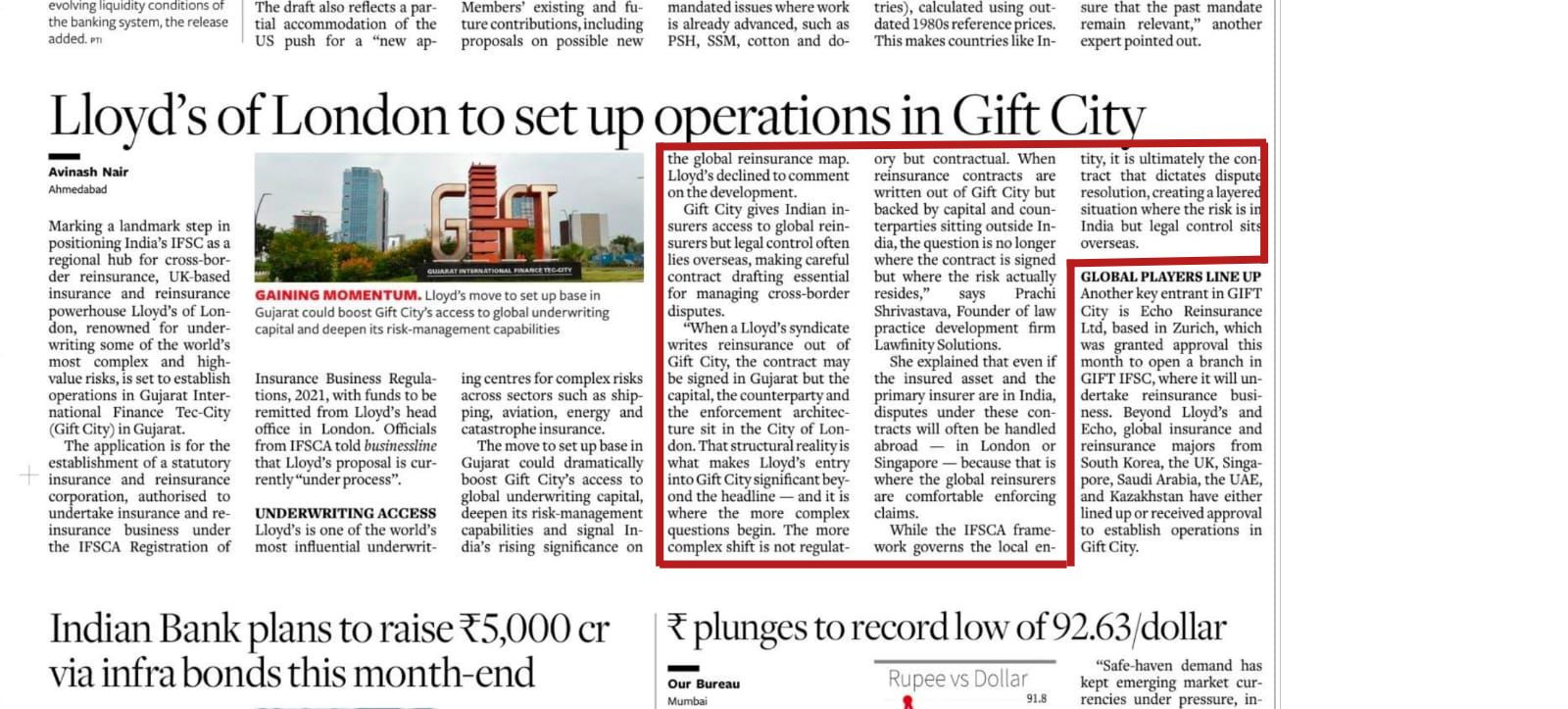
When a Lloyd’s syndicate writes reinsurance out of GIFT City, the contract may be signed in Gujarat but the capital, the counterparty, and the enforcement architecture remain in the City of London. That structural reality is what makes Lloyd’s pending entry into GIFT City significant for international disputes and insurance practices.
And it is where the more interesting strategic questions begin.
India’s insurance market is estimated at $129 billion and ranked tenth globally. GIFT City offers a 10-year tax holiday, capital gains exemptions, and a regulatory framework that allows foreign reinsurers to follow home-country solvency norms rather than India’s domestic 150% solvency ratio requirement. 14 global reinsurers already operate from GIFT City, managing annualised premiums of $700-800 million. Regulators expect that number to reach 20 by FY 2026-27. Lloyd’s, Samsung Re, Mapfre Re and Kenya Re are among those seeking approval.
That is the access story. The mandate story is different.
Where the legal work will actually arise
In most GIFT City reinsurance structures, the underlying insured risk sits in India. The primary insurer is Indian. But the reinsurance contract governing that risk will typically be subject to English or Singapore law, seated in an offshore arbitration jurisdiction, and enforced against balance sheets outside India entirely.
The IFSCA framework governs the entity. The contract governs the dispute.
A January 2025 judgment from the English Commercial Court illustrates precisely what that means in practice. In Tyson International Company Ltd v GIC, the court was asked to determine which dispute resolution clause governed a reinsurance arrangement between Tyson’s captive insurer and GIC (India’s national reinsurer) and its most internationally experienced. The Market Reform Contract provided for exclusive English court jurisdiction. A facultative certificate executed nine days later contained an arbitration clause. When a claim arose following a fire at a Tyson plant, GIC declined to indemnify. The central legal question was not whether the claim was valid. It was which document (and therefore which forum) controlled the dispute.
The court held that the facultative certificate superseded the MRC, giving the arbitration clause precedence. But the more important point for any firm building an India reinsurance practice is this: the entire dispute turned on a nine-day gap between two documents and the absence of a hierarchy clause that the London Market Group’s own guidance acknowledges should be checked but does not require.
A drafting omission of that kind produces more than a regulatory problem. It leads to dealing with the jurisdictional question. And GIC is not an inexperienced counterparty. It is India’s state-backed national reinsurer with decades of London market exposure.
For newer Indian market participants entering GIFT City structures for the first time, the jurisdictional risk is higher, not lower.
What this means for firms watching the corridor
The mandates that will flow from GIFT City’s reinsurance expansion will not be straightforward Indian law matters. They will require practitioners who can navigate the intersection of IFSCA regulation, London market documentation practice, and offshore arbitration procedure, simultaneously. The disputes will be seated in Singapore or London, but the underlying relationships, counterparties, and risk contexts will be Indian.
This creates a specific kind of practice opportunity that is neither pure India work nor pure international arbitration. It sits at the boundary.
The firms best positioned to capture it will be those that understand how Indian insurers and reinsurers think about risk and relationship. This is a larger mandate than the knowledge of how to run an LCIA or SIAC arbitration. These firms will need to come with established credibility within India’s insurance ecosystem before the disputes arrive.
The new products that global reinsurers plan to introduce through GIFT City (Example, surety bonds, parametric insurance, cyber risk policies, marine coverage) are precisely the product lines where documentation standards are still being established and where the gap between commercial expectation and contractual language tends to be widest.
Those gaps are where disputes form.
The timing question
The window for positioning is now, not when the first significant GIFT City reinsurance dispute is filed. By that point the counterparty relationships, the panel counsel arrangements, and the institutional familiarity will already be in place for the firms that moved earlier.
India’s reinsurance market is in the middle of a structural transition: from a GIC-dominated, domestically oriented market to one where global capital, global documentation standards, and global dispute resolution norms are being introduced simultaneously.
That transition will produce the kind of complex, high-value cross-border disputes that define practice areas for a generation.
The contracts being signed in GIFT City today will be tested in courts and tribunals outside India. The question for Singapore and London practices is not whether to watch this corridor. It is whether they are already inside it.
Also read our take on how cross border disputes form, covered over at Bar and Bench earlier this week, and our comment to The Businessline on the Loyd’s market access story.