Watch in 1 minute video here.
Scope: this is a note on how legal work in this corridor is bought, sold and presented. It is not legal analysis. It does not address the separate proceedings concerning domestic lender share pledges, and a forensic audit order is investigative and it establishes no wrongdoing on anyone’s part.
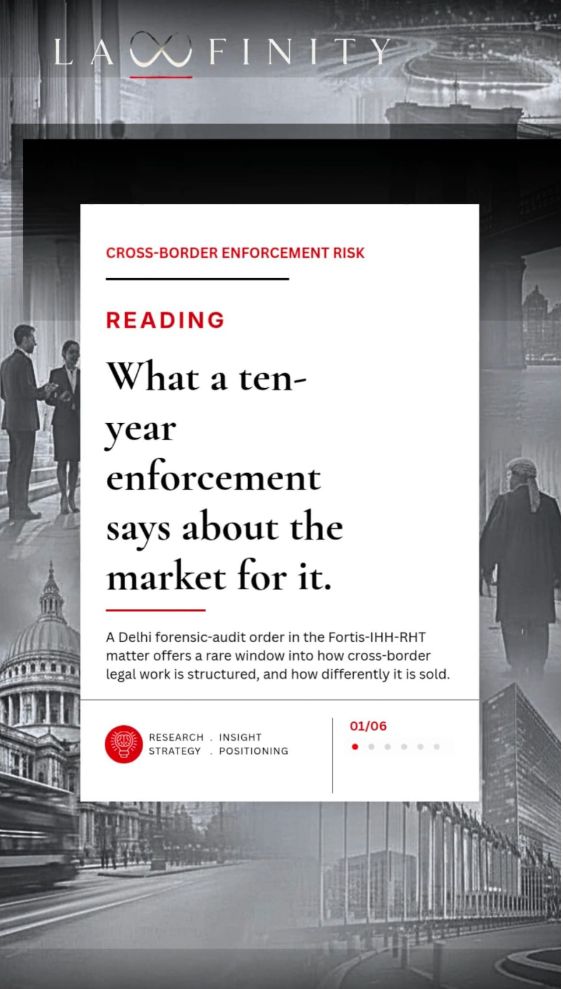
I was asked to comment for Business Standard on the Delhi High Court’s order appointing a forensic auditor to examine transactions involving Fortis Healthcare, IHH Healthcare and Singapore-listed RHT Health Trust. My interest in matters of this kind is not the law, which is for counsel. It is that a proceeding running this long, across these many jurisdictions, is one of the few available windows into how legal services in this corridor are actually structured. This event also tells us how the way firms present themselves diverges from where the work turns out to be.
Three observations, none of which requires a view on the merits:
The marketable part of this engagement was the short part. An award was obtained in Singapore in 2016. Everything since has been realisation including execution, tracing, applications, appeals, and now forensic audit, across a decade and multiple forums. We can reasonably guess at the shape of the mandate: the adjudication was a defined engagement with a definite end, and the enforcement has been an open-ended one. Disputes practices are organised, staffed and marketed around adjudication. The economics of matters like this sit substantially in enforcement.
The person buying the work changes partway through. At the arbitration stage the instructing party is typically a General Counsel with a mandate to pursue a claim. By the enforcement stage, particularly where a claim has been funded or partly monetised, the effective decision-maker is often a recovery function or a litigation funder. Funders commission their own investigative and asset-tracing work as a condition of capital, from specialist investigative firms rather than from law firms. A practice that has built its relationship with the GC may find, years in, that It has no relationship with or understanding of the actual decisionmaker.
The contagion risk has no instrument. IHH’s mandatory open offer has been suspended since December 2018, in proceedings where the structure of the transaction has been challenged. It is not the judgment debtor. The transaction is within scope because of where consideration is alleged to have travelled.
Commercially relevant is the fact that escrows, holdbacks, indemnities and legal opinions address seller solvency, title and specific identified liabilities. They do not address a court-ordered freeze on a regulatory obligation, running for years, in proceedings to which the buyer is not a party and over which it has no control. Deeper diligence is not obviously the answer either because a non-cooperative seller will not open personal litigation files. Diligence that identifies the exposure still cannot remove it.
The market may not yet have addressed the real, material risk.
Which brings me to the part that is properly my subject.
Almost none of the work described above will appear in anyone’s credentials. Directory submissions, pitch documents and practice pages are built around awards obtained, values secured, tribunals appeared before. They are not built around nine years of tracing, or an execution strategy that survived four appellate rounds.
The consequence is a public evidence base for this corridor that describes adjudication capability in detail and realisation capability barely at all. The clients who have been through one of these matters know exactly which of the two was harder to find.
Lawfinity Solutions advises international law firms on cross-border legal market positioning. If the India corridor is a live question for your firm, we would be interested in a conversation. Lawfinity works with one firm per jurisdiction. Engagements begin with a single conversation about your firm’s current position and where the corridor question is live for you. Write to Prachi Shrivastava