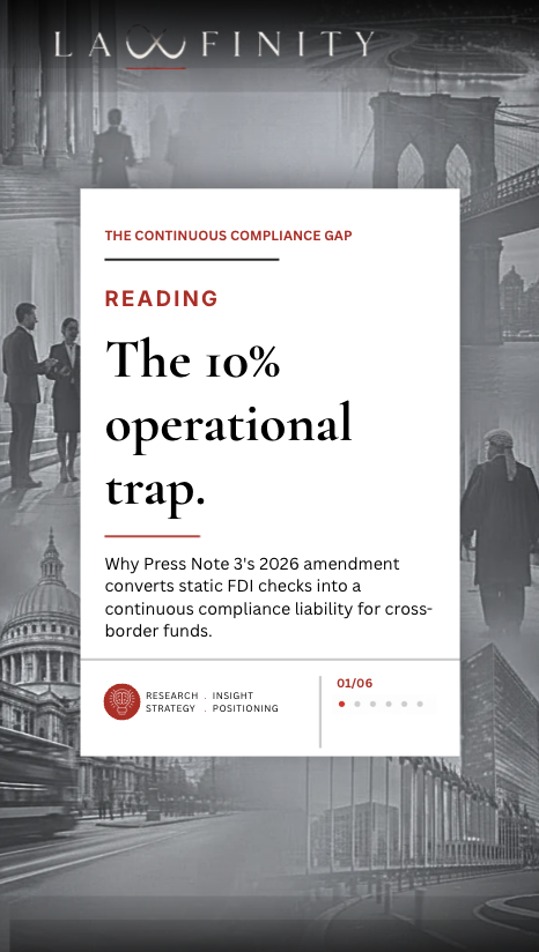
When India’s Union Cabinet amended Press Note 3 in March 2026, the headlines recorded a policy easing. Foreign investments carrying non-controlling land-border beneficial ownership of up to 10 per cent can now enter through the automatic route, and a 60-day timeline has been introduced for processing proposals that still require approval.
For Chinese corporates expanding through offshore joint ventures and Hong Kong or Singapore holding structures, and for funds carrying mainland LP capital, the clarification issued by the Department for Promotion of Industry and Internal Trade the following day contains the relevant distinction.
Entities registered in China or Hong Kong, and direct investments by Chinese citizens, continue to require prior government approval without exception, whatever the stake size. The 10 per cent position is available only to non-land-border vehicles in Cayman, Singapore, European and similar regions carrying small, non-controlling land-border beneficial ownership.
So the relaxation is not an opening for direct Chinese capital. It is an opening for structures that hold Chinese money in a minority.
From a point-in-time check to a continuous condition
The original 2020 Press Note posed a binary question at closing: “Was there a land-border beneficial owner”? There was no de minimis, which is why funds with negligible exposure were caught and why the rule was amended.
The 2026 amendment replaces that with a threshold in two limbs. Beneficial ownership must be no more than 10 per cent, and it must be non-controlling.
A threshold behaves differently from a binary test. A binary test is answered once and the answer holds. A threshold can be crossed years later without any decision by the Indian investee or the investor:
- A limited partner sells its interest on the secondary market and the buyer’s own ownership chain carries land-border exposure.
- A fund-of-funds several layers up restructures its investor base.
- Convertible instruments in an offshore holding company convert, diluting other capital and lifting the relevant percentage past the line.
The structure is compliant on day one. By year three a passive shift has produced an unapproved position under the exchange control regime, with no one having done anything.
The control limb is the sharper of the two
The second condition is qualitative, and it is more concrete than it first appears.
Control under the non-debt instrument rules is a defined concept rather than a matter of regulatory discretion. It includes the right to appoint a majority of directors, and the right to control management or policy decisions, including by virtue of shareholding, management rights, shareholders agreements or voting agreements.
That definition is not percentage-bound. A minority investor holding a board seat, veto rights over material decisions, or reserved matter protections may satisfy it at a stake well below 10 per cent. And those rights are renegotiated in later funding rounds by people who are not thinking about Press Note 3 at the time.
An investment can therefore fail the second limb while comfortably passing the first, and can begin to fail it in a round that had nothing to do with the land-border question.
Why the client pays for this, and when
Authorised dealer banks verify the position at the point of filing and do not audit upstream changes over the life of an investment, so there is no supervisory event that forces the question.
But the audit happens at exit.
Buyer’s counsel on a later round, an acquirer’s diligence team, or an underwriter running pre-IPO diligence will examine the historical position. A passive breach in year two, for example, a stake drifting past the line through a secondary transfer not notified, surfaces there, as an unremedied historical contravention sitting under the transaction. The discovery happens at a time when the problem is expensive beyond the affordability of the party that makes the discovery.
The service is not compliance monitoring. The mandate here can be to ensure that an investment which entered cleanly is still capable of being exited.
The information problem
An Indian investee company files and reports but has no visibility into its investor’s upstream ownership. An offshore fund manager cannot compel its limited partners to disclose changes in their own beneficial ownership. The party with the obligation has no information and the party with the information has no obligation.
This asymmetry is solved contractually, in the fund and shareholder documentation, at the point when the documents are being negotiated rather than after. It requires someone to have identified the risk while there is still leverage to allocate it.
Two open questions
Two things are not settled and should be treated as open rather than assumed.
The first is which definition of beneficial ownership applies. India has several, at different thresholds, under different statutes. Which one the amended framework adopts determines how the 10 per cent is calculated and how far up a chain the enquiry runs.
The second is what the 60-day timeline actually confers. It is an obligation running toward the government. Nothing published indicates what an applicant is entitled to on the sixty-first day. Until that is answered it is a service standard rather than a right.
Lawfinity Solutions advises international law firms on cross-border legal market positioning. If the India corridor is a live question for your firm, we would be interested in a conversation. Lawfinity works with one firm per jurisdiction. Engagements begin with a single conversation about your firm’s current position and where the corridor question is live for you. Write to Prachi Shrivastava