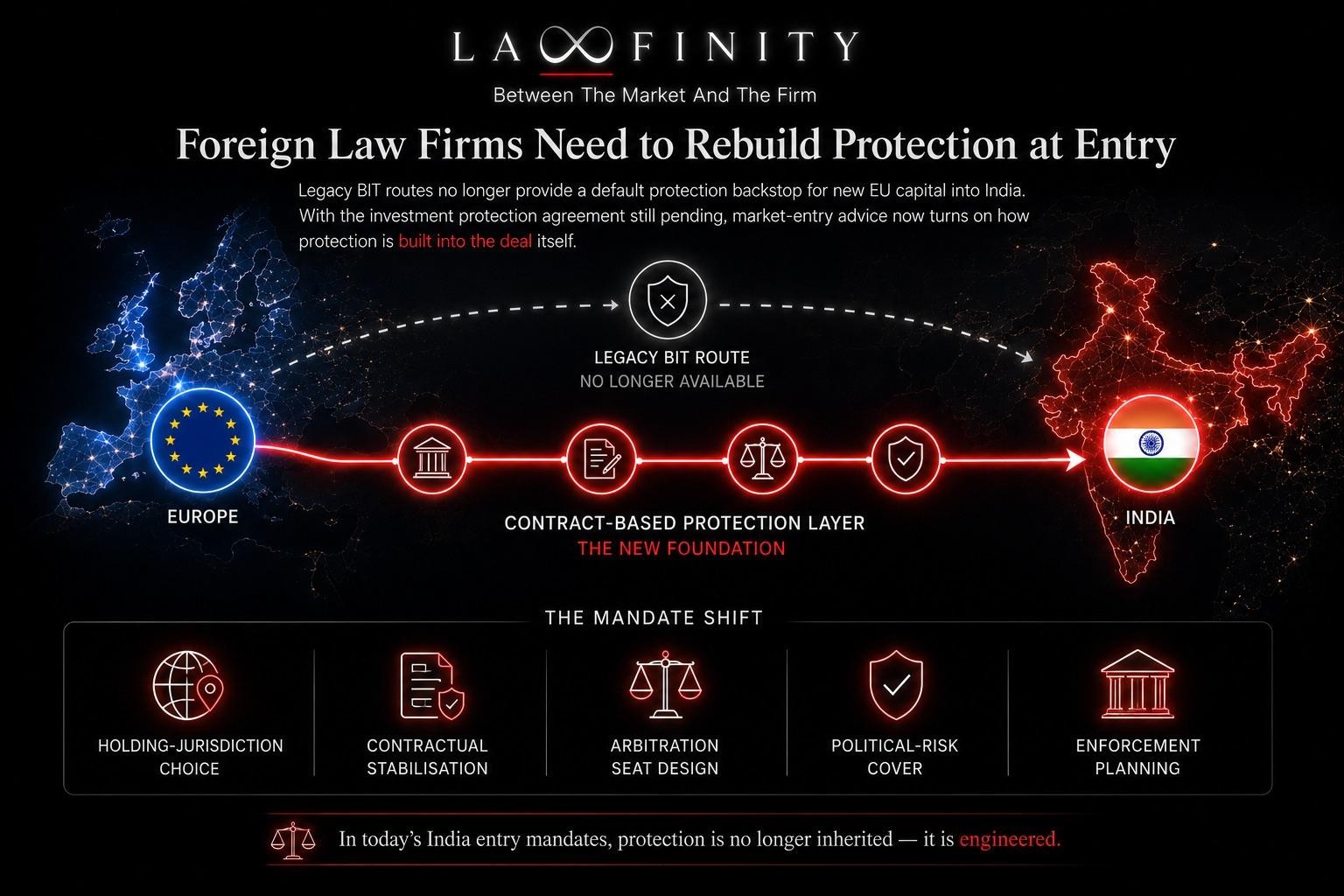
The landmark EU-India free trade agreement, concluded on 27 January 2026, has radically reshaped the competitive dynamics of the India cross-border legal corridor. While the deal’s twenty chapters establish unified frameworks for digital trade, intellectual property, and public procurement, its investment chapter has been completely decoupled, marooned in a parallel Investment Protection Agreement (IPA) that remains unresolved.
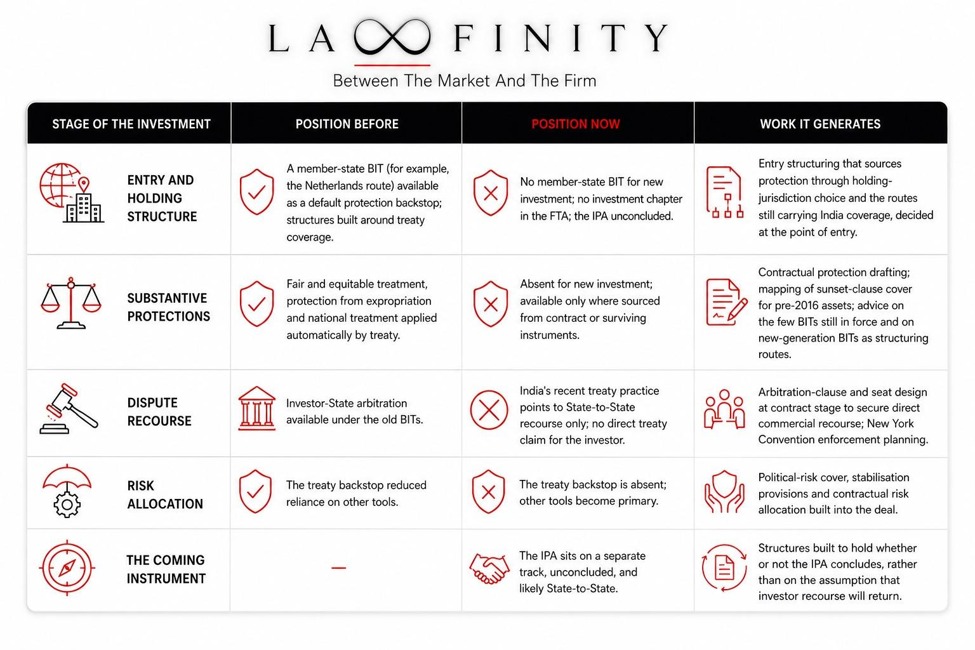
This regulatory vacuum is the central commercial fact governing how cross-border legal mandates are instructed and which law firms capture them. Between 2016 and 2024, India systematically terminated 77 legacy BITs, including vital capital-routing agreements with the Netherlands, Germany, and other EU states. Furthermore, India’s modern treaty practice (reflected in accords like the 2024 EFTA deal) consistently mandates a strict 5-year exhaustion of local remedies and replaces direct investor-state arbitration with far more restrictive state-to-state frameworks.
As a result, the traditional public international law safety net foreign investors relied on has evaporated. Fresh EU capital now enters the Indian market wholly exposed – and the law firms positioned to immunize it are those who can inject bespoke contractual protections directly into deal structures at the point of entry.
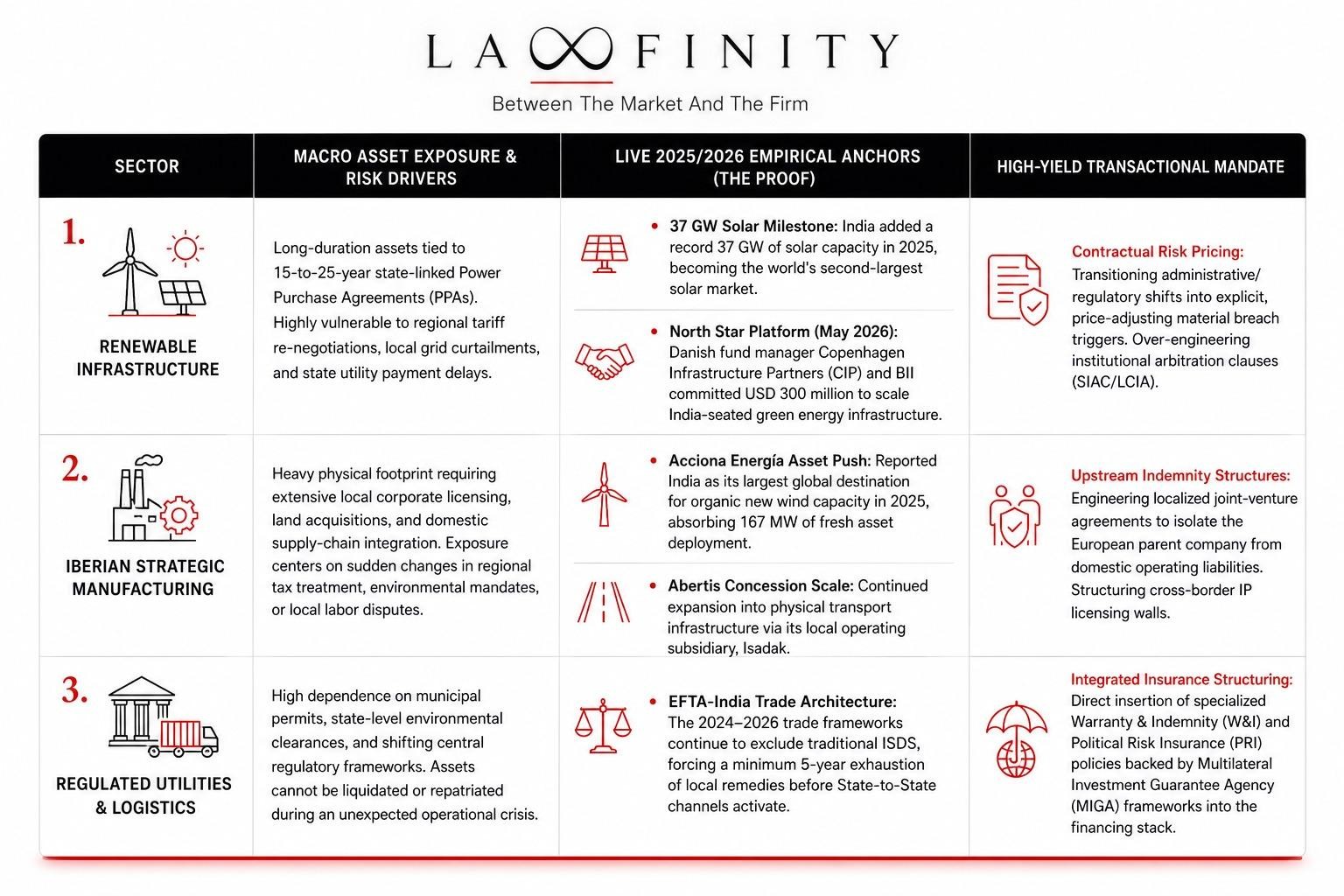
Where the Asset Exposure Concentrates
To help general counsel and transaction partners quickly diagnose where the cross-border legal market demand is concentrated, the India investment protection gap can be mapped across three capital-intensive sectors
The Protection Position, Before and Now
Analysis of 2025–26 FDI flows from Denmark (North Star Platform), Spain (Acciona/Abertis) and the EFTA bloc confirm these sectors are where the India legal market opportunity for foreign firms is concentrated.
The Capability Mismatch: Who Owns the Front-End Mandate?
With treaty coverage gone, the cross-border legal work has migrated from the disputes phase to the transactional stage. Securing an asset now requires engineering public international law protections into private deal documents at the term-sheet level – a capability incumbent firms are not structured to deliver.
While elite global firms house both corporate and investor-state arbitration practices, their internal silos block effective integration. M&A partners are incentivized by deal speed; treaty safeguards get relegated to ‘midnight boilerplate.’ Disputes practices engage only after an investment does sour. The two worlds rarely intersect when the deal is inked – leaving assets unprotected in volatile emerging markets.
The New Framework of the Mandate
The firms positioned to capture the India cross-border legal market are those collapsing this silo, injecting sovereign risk immunisation directly into deal negotiations. Lateral partner moves and dedicated India desk launches in Singapore, London and Dubai reflect the ongoing race to close this capability gap.
For a repositioning entrant, the competitive gap left by incumbents is stark. Sophisticated clients – especially institutional infrastructure funds and industrial conglomerates, are no longer accepting standard corporate boilerplate that assumes a non-existent treaty safety net.
The mandate belongs exclusively to the advisors who can actively bridge this divide: those who can translate public international law protections into private contract mechanics, and who deploy that capability the exact moment the inbound investment decision is taken.
Timing and Positioning: Capitalising on the Ratification Window
Succeeding in the India legal market as a foreign firm requires engaging during the pre-investment structuring window – not waiting for disputes to arise. With the 2026 EU-India trade deal now in ratification, European investors are actively converting new market access into onshore capital commitments. This is triggering an immediate spike in front-end mandate formation.
Law firms that successfully internalize and pitch dual corporate + protection capabilities during this window will lock in long-horizon advisory relationships. Those still operating in silos will be structurally excluded, regardless of brand or scale.
Until the EU-India investment protection agreement is finalized, ratified, and implemented, this private law vulnerability remains. The firms that adapt their India market entry strategy now are the ones that will dominate the corridor’s legal market for years to come.
________________________________________
General commentary on the public treaty position as at June 2026; not legal advice. Treaty status and negotiating positions are subject to change.
Lawfinity Solutions advises international law firms on cross-border legal market positioning. If the India corridor is a live question for your firm,we would be interested in a conversation. Lawfinity works with one firm per jurisdiction. Engagements begin with a single conversation about your firm’s current position and where the corridor question is live for you. Write to Prachi Shrivastava