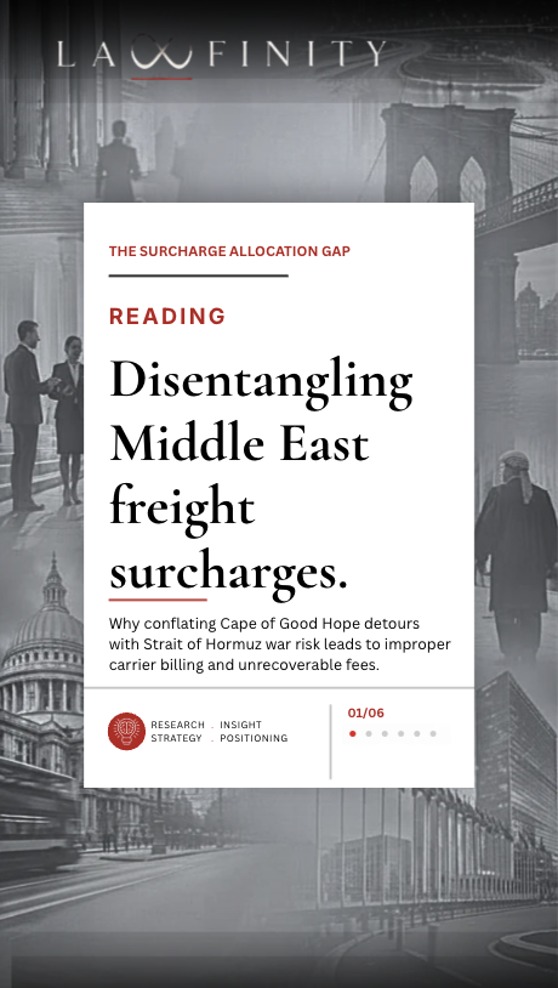
Major ocean lines and freight forwarders are levying emergency surcharges across global supply chains in response to Middle East disruption. Closer inspection of cargo bills suggests two distinct commercial cost events are being conflated under a single “Middle East Disruption” fee.
The Geographic Conflation: Cape Detours vs. Hormuz Risk
To evaluate whether a surcharge is contractually recoverable, two distinct maritime risks have to be separated:
The Cape of Good Hope Detour (Physical Extra Distance): To avoid missile threats in the Red Sea, vessels traveling between Asia and Europe bypass the Suez Canal, sailing around Africa instead. This adds 10 to 14 days, thousands of nautical miles, and heavy bunker fuel costs. It is a physical route deviation.
The Strait of Hormuz Risk (Pure Insurance Repricing): The Strait of Hormuz is the sole maritime entrance into the Persian Gulf. There is no “detour” around Hormuz. A container heading into Jebel Ali or Ras Tanura either sails through the strait or stays at the dock. The cost spike here is not extra fuel or days at sea; it is War Risk Additional Premium (AP): an insurance surcharge levied by underwriters on a per-voyage basis.
The two are easy to tell apart on a specific lane. An Asia to Jebel Ali sailing transits Hormuz and never approaches Suez. It incurs war risk premium and no diversion cost at all. So where a levy described as a Cape or diversion surcharge appears on that lane, the question a shipper can answer from its own invoices is whether the cost being recovered was incurred on the voyage it is charged to.
Contractual Mechanics: What the Clause Allows
A surcharge is a unilateral contractual recovery, and its enforceability depends on the drafting mechanism. Two separate relationships are in play here, and they are governed by different documents.
Carrier to shipper. This is the bill of lading and, where one exists, the service contract. If the tariff is properly incorporated and permits recovery of actual extra voyage miles or detour expenses, Cape-rerouted sailings qualify and Persian Gulf sailings do not. If the arrangement is a fixed-rate annual service contract, the carrier cannot introduce an emergency levy at all unless the contract defines an adjustment trigger, and the levy has to fall within whatever that trigger describes. A general rate increase is a change to the base rate on notice, which is a different instrument from an emergency surcharge and should not be used to justify one.
Owner to charterer. This is the charterparty, and it is where CONWARTIME and VOYWAR operate. Those clauses do allow additional war risk insurance premiums to be passed to charterers, subject to the drafting and to the owner establishing the cost actually incurred. They have no application to a liner surcharge on a shipper, and citing them in that context confuses the two relationships in the same way the surcharge notices do.
The “Fixture-to-Sailing” Insurance Trap
For energy traders and commodity charterers operating in the Gulf, the bigger exposure is timing. War risk insurance is quoted voyage by voyage, and brokers have reported additional premium moving across a wide range of hull value as Gulf conditions deteriorate, with rates capable of changing within days.
If the charterparty does not clearly state who absorbs insurance hikes occurring between fixture and sailing, the owner, charterer, and cargo owner end up in an immediate, high-stakes dispute before the cargo even unloads.
The same gap runs into the sale contract. Where a delivery window is missed because cover was withdrawn or repriced rather than because of any physical impediment, most trade documentation does not say clearly whether that is an excusable delay or a default. That question is answered by neither the war risk clause nor the force majeure clause in the terms most parties are using.
What Follows
Isolating the physical route detour from the insurance repricing is the whole of it. Once those two costs are separated on a given lane, a shipper can establish what was actually incurred, a charterer can identify who bears a premium that moved after fixture, and both can reopen a commercial conversation from a position they can evidence.
None of that requires an arbitration, and most of it will not produce one. It requires somebody to read the surcharge notice against the contract it is applied under, which is a records exercise before it is a legal one.By isolating physical route detours from insurance rate hikes, law firms can help clients reopen commercial negotiations, recover improperly levied surcharges, and lock in clear risk allocation before the next shipping disruption hits.
Lawfinity Solutions advises international law firms on cross-border legal market positioning. If the India corridor is a live question for your firm, we would be interested in a conversation. Lawfinity works with one firm per jurisdiction. Engagements begin with a single conversation about your firm’s current position and where the corridor question is live for you. Write to Prachi Shrivastava