A newsletter I have some responsibility for went out this morning, on time and with nothing wrong in it, and I spent longer than I expected looking at the template. It was designed about two years ago, properly and to a law firm’s brief, and at the time it was right. What struck me is that it is no longer right, and that nothing has happened to it in the meantime.
The firm it represents has added practice areas, moved noticeably upmarket in the instructions it takes, and is now read by people who were not on the list two years ago. The design was pitched at the firm that commissioned it, and that firm has ceased to exist as it happens in the ordinary course of doing well.
Designing it was within our scope. Producing it monthly is within our scope. Noticing that it has drifted is not within scope. It would be difficult to scope because who is to say in advance the month in which an asset will begin to misrepresent the practice it belongs to. Does my observation about the lag get actioned, or does it die an unceremonious death? That depends entirely on whether the engagement has any room in it: somebody absorbs the work, or it waits until the next annual conversation about scope, or it does not happen. In the meantime the newsletter continues to go out, correctly, and every measure anyone has agreed to says the arrangement is working.
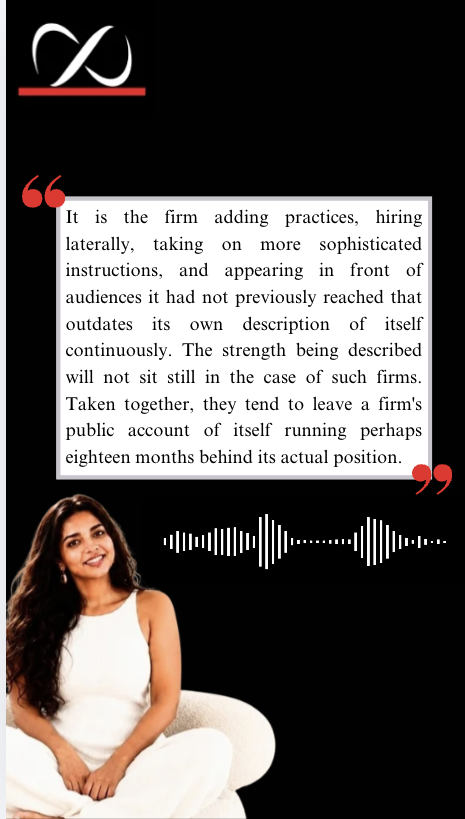
I have come to think the more interesting feature of this is that the rate at which it happens is a function of how well a firm is doing. A practice that is holding steady can leave its materials alone for years without their becoming inaccurate. It is the firm adding practices, hiring laterally, taking on more sophisticated instructions and appearing in front of audiences it had not previously reached that outdates its own description of itself continuously. The strength being described will not sit still in the case of such firms. The firms least troubled by any of this are, on the whole, the ones with least to say.
Across a year it is never a single newsletter. It is a biography that leads on work the partner has largely left behind, a practice page written before the firm began offering what it now leads with, case notes pitched at a client type that seemed like the priority two strategy conversations ago. These tasks individually fall just short of requiring a re-opening of scope. Taken together they tend to leave a firm’s public account of itself running perhaps eighteen months behind its actual position. So then that becomes the interval at which a general counsel’s impression of this firm becomes outdated.
Law firms have been carrying similar costs on their mandates as well. They do not bill a client for maintaining a precedent bank. Templates are drafted once and then age against amended legislation, new authority and shifting market practice, and keeping them current is continuous, unattributable to any particular file, and absorbed. A firm attempting to bill precedent maintenance to a matter would not get far, and a firm that never did it at all would be exposed in a dangerously invisible way. Know-how sits in the same category: nothing fails visibly, the function simply becomes less useful over time. With passage of time it becomes harder to pinpoint the exact point at which irrelevance creeped in. Public materials belong to that class of asset and are seldom treated as though they do.
I notice the same thing from the other side of it. I rewrite my own practice’ materials more or less continuously including the website, the way the offering is described, the biographies, the framing of an approach. This is hardly ever because the direction changed. The direction has remained steady and focussed. It is that each contact of ours with the market shows up something imprecise: a claim doing less work than it should, a formulation that read well two months ago and now reads like the sort of thing anyone might say. The process converges rather than wanders. But it has no natural stopping point and no unit of measurement, and had I been asked in January how many hours of it this year would require, any figure I gave would have been wrong. It is hard to scope work and where a scope has been priced to its last hour, this kind of nuanced senior judgment is the first thing to stop.
None of the above is an argument against defining what is being bought. Where a law firm knows precisely what it needs (a submissions cycle, a rebuilt website, a media programme) the decision has already been taken. In such cases the work should be specified tightly and delivered as written.
It is more that some of this work consists largely of noticing, and noticing does not schedule. If I were assessing anyone responsible for how a firm presents itself, the question I would find most revealing at the end of a year is what they changed because it had stopped being right, as distinct from what they changed because it was due. If all amendments occurred per a pre-designed schedule, the firm being described is, in all likelihood, the firm as it stood at the last review.
Lawfinity Solutions advises international law firms on cross-border legal market positioning. If the India corridor is a live question for your firm, we would be interested in a conversation. Lawfinity works with one firm per jurisdiction. Engagements begin with a single conversation about your firm’s current position and where the corridor question is live for you. Write to Prachi Shrivastava