Most law firms have a reasonably clear picture of the mandates they pitched for and lost. Very few have any picture at all of the mandates they were never considered for which, for most firms, is by a wide margin the larger number.
This is worth more attention than it usually gets, because by the time a firm is invited to pitch, the decisive judgement has generally already been made. The shortlist is the decision. What follows is a comparison between survivors.
How a shortlist actually forms
A client needs counsel for something specific. Depending on the institution, what happens next takes one of a few forms. A general counsel asks two colleagues who they have used for this. A legal operations team pulls an internal panel list assembled some time ago for reasons now forgotten. A procurement function opens a process with published criteria and a closing date. An intermediary such as a merchant banker or an insolvency professional or an accountant is asked to suggest someone, and suggests whoever handled the last mandate without incident.
Three or four names surface. Somebody then checks them.
A deeper understanding of the intention behind that check reveals that it is hardly an assessment of quality. It is a corroboration exercise, conducted quickly, usually by someone junior, and its question is narrow: is there anything to substantiate this name? A directory entry. A reported matter. Published analysis on the point at issue. A practice page that reads as though it were written by someone who does the work rather than by someone describing it.
Names that survive corroboration go forward. Names that do not get dropped without any hearing.
Two failures that look identical
So there are two distinct ways to lose a mandate you were never formally in contention for, and they have almost nothing in common.
The first is that your name never came up. No one in that conversation had a reason to think of you. They overlooked you not because they judged you unsuitable, but because you were not in the set of firms they were choosing between. This is a question of who knows what about your practice, and when they last had cause to remember it.
The second is that your name came up and did not survive corroboration. Someone put you forward, a colleague spent four minutes checking, and found insufficient support for the recommendation. This is a documentary problem, and it is unforgiving in a specific way: the more senior the person who recommended you, the more damaging the failure, because they will be slower to do it again.
Both failures produce exactly the same signal from where you sit, which is silence. How many times have you received a communication to tell you specifically that you were considered and dropped? Or that you were never considered? The firm sees an absence and has no way of telling which absence it is looking at.
Why the diagnosis usually goes wrong
Faced with an undiagnosable problem, firms tend to reach for the interpretation that has an obvious response attached. The corroboration failure has suppliers for content, directories, submissions or a Google search. It is legible, it can be scoped, and something visible happens once you buy it.
The other failure has no obvious supplier and no obvious deliverable, so it tends to be reclassified as a version of the first. A firm concludes it has a visibility problem, addresses that, improves its documentary position and finds that the shape of its practice has not moved, because even after that step its name is not coming up in the conversations where work is allocated.
The documentary work is necessary. A firm that cannot survive corroboration will convert nothing, however well-connected it is. But it is a condition of being chosen, not a cause of being considered. Those are different problems and they yield to different things.
Why this is becoming more acute
For most of the professional lifetime of anyone reading this, instruction was substantially personal. A client had a lawyer; the lawyer moved firms and the client often followed.
That mechanism has not disappeared, but it is increasingly mediated. In-house teams have grown and formalised. Panel reviews run on cycles with criteria. Procurement participates in decisions it previously did not see. Each of these interposes a process between the relationship and the instruction and every process has a verification step in it.
The practical consequence is that reputation-follows-work, which has served good firms honourably for a long time, now operates with a filter in front of it. The filter does not assess your work. It assesses whether anything about your work can be established by someone who has four minutes and a search engine.
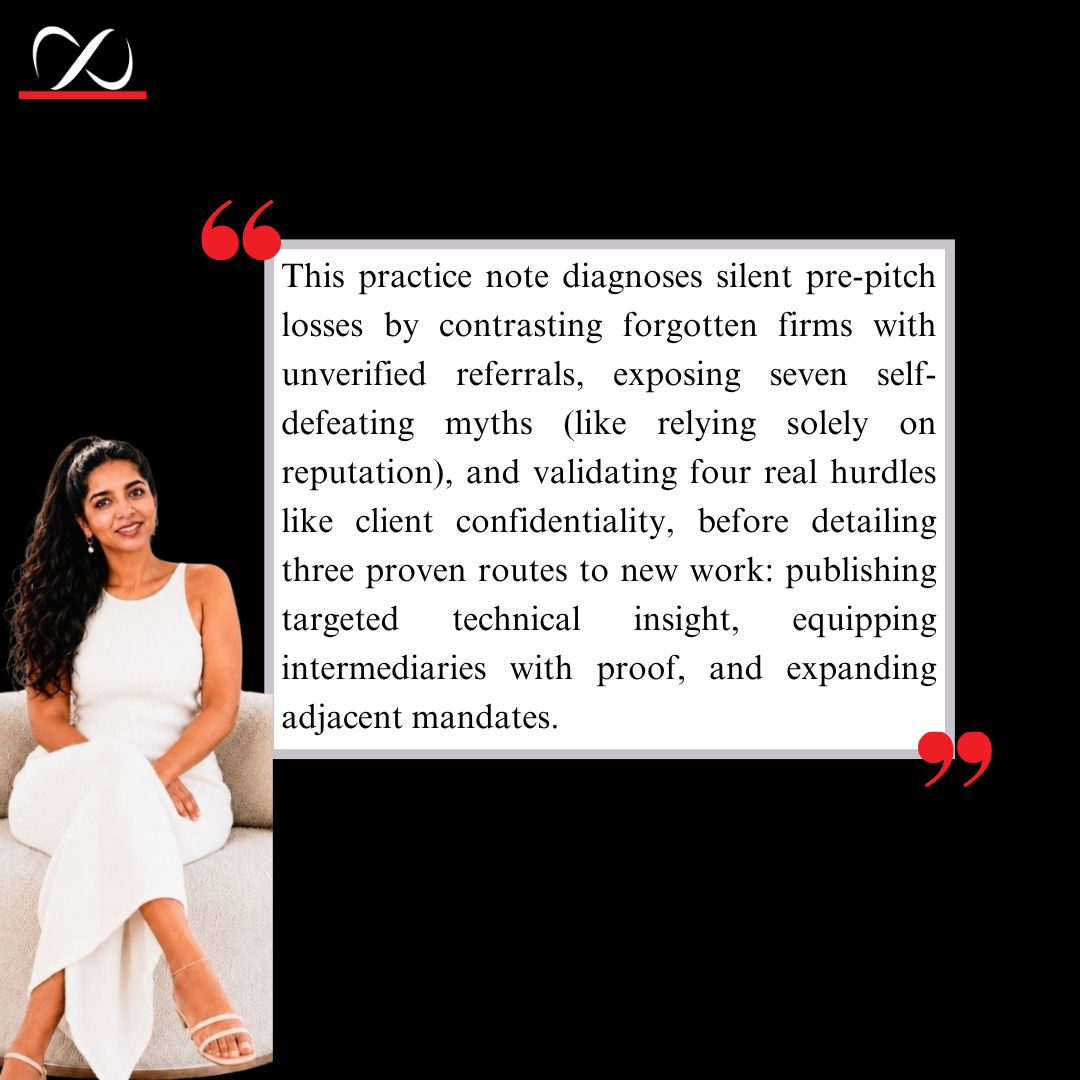
I have set out the full working of this in a practice note, drawn from a single continuous engagement with one Indian commercial firm since March 2021 – now ranked by IFLR1000, Asialaw, Legal 500 Asia Pacific and India Business Law Journal, with both partners holding consecutive A-List placements, acting for a national regulator and several of India’s largest corporates.
It covers how to tell the two failures apart, the seven assumptions that most reliably keep a good firm out of consideration, the four objections to addressing it that are entirely valid, and the three routes by which a practice acquires work of a kind it has never been instructed on before.
The Legibility Deficit – Practice Note No. 1 →
Lawfinity Solutions advises international law firms on cross-border legal market positioning. If the India corridor is a live question for your firm, we would be interested in a conversation. Lawfinity works with one firm per jurisdiction. Engagements begin with a single conversation about your firm’s current position and where the corridor question is live for you. Write to Prachi Shrivastava